
Hospital Power Backup Planning: A Practical Guide to Emergency Power Supply for Hospitals
A hospital never gets to pause. Ventilators keep running, surgeons keep operating, and refrigerators keep blood and medicine cold, even while a storm takes down the grid. That's why hospital power backup planning sits at the top of every facility manager's list. Get it right and patients barely notice an outage. Get it wrong and the stakes are painfully high.
This guide walks you through emergency power supply for hospitals in plain language. We'll look at the codes that set the rules, hospital electrical system design, hospital electrical load calculation, hospital generator sizing, hospital UPS system requirements, and the testing routine that proves it all works. The technical details come from NFPA standards, the National Electrical Code (NEC), The Joint Commission and engineering publications, so you can trust the numbers.
Why Hospital Power Backup Planning Needs Early Attention
Backup systems are hard to fix after the building is finished. Switchgear rooms, fuel storage, and cable routes all take space, and moving them later costs real money. Backup supply also has to work alongside every other utility in the building, which is why it belongs inside your wider hospital MEP systems planning from day one. Planning early lets you decide which loads must stay alive, how fast they need to restart, and how many hours of fuel you want on site.
Good planning also keeps you on the right side of inspectors. NFPA 110 is referenced by other standards, including the NEC, NFPA 99 and The Joint Commission's hospital accreditation standards, so one weak link can affect compliance across the board.
The Codes That Shape Hospital Electrical System Design
Two Independent Sources
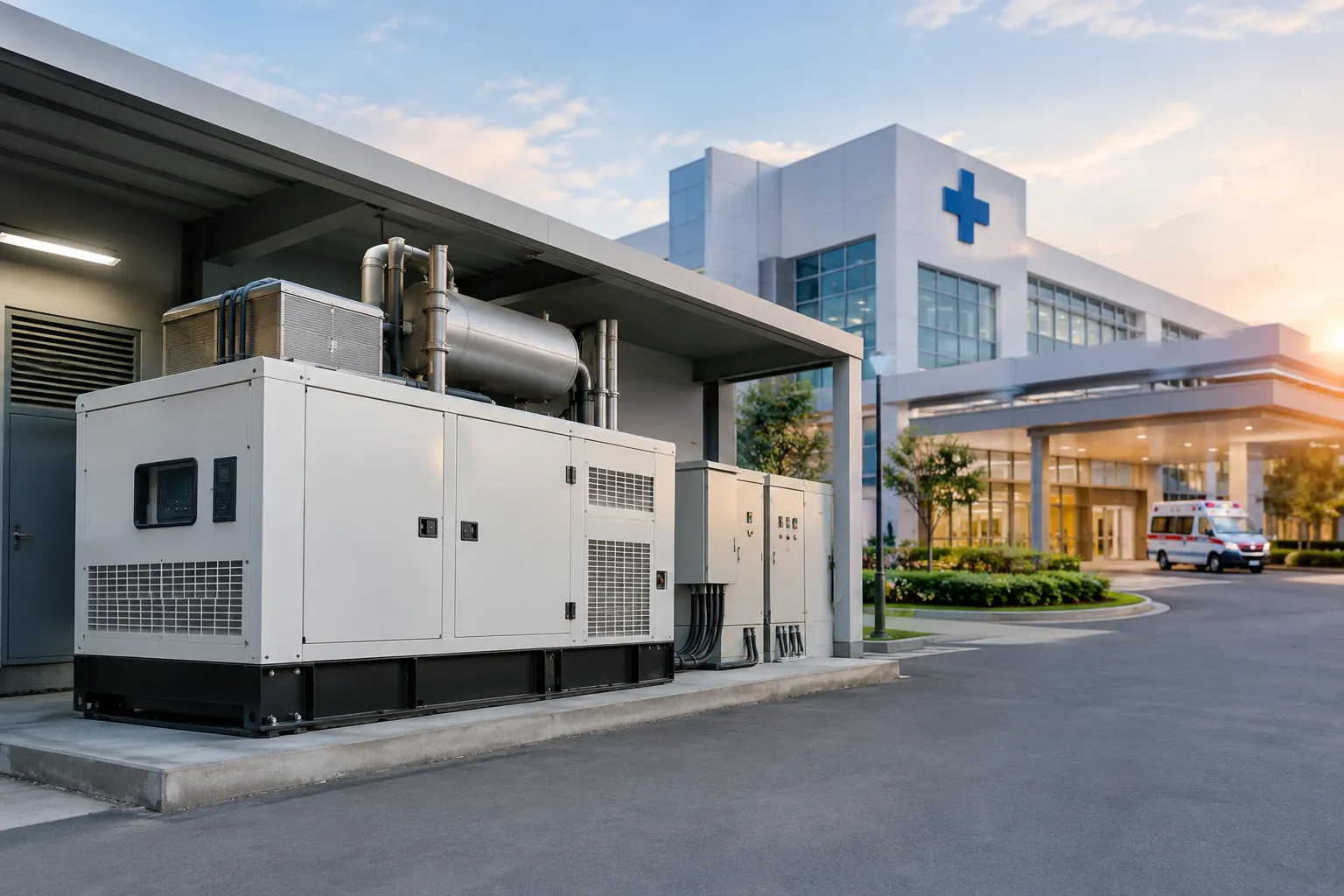
The NEC requires every hospital to have two independent sources of electricity: a normal source, which is the utility, and an alternate source, such as a generator, fuel cell system or battery system. Hospital generators are usually rated for standby use because they act as that alternate source, as explained in this overview of hospital emergency power supply systems.
How NFPA 99 and NFPA 110 Work Together
NFPA 99, the Health Care Facilities Code, answers the "where and why" question. It looks at the risk to patients and decides which spaces need backup. NFPA 110 covers the hardware. It sets how the emergency power supply (EPS) and the wider emergency power supply system (EPSS) must perform. One detail worth knowing: NFPA 110 doesn't decide which loads fall under which category. Designers also review NFPA 99, NFPA 101 and the NEC.
Class, Type and Level Explained
NFPA 110 describes every system with three labels. The table below breaks them down.
| Label | What it defines | Hospital relevance |
|---|---|---|
| Class | Minimum run time in hours | Some sources cite Class 96 or a plan to supply 96 hours of fuel; others note Class 48 is typical. NFPA 99 references Class X (a custom duration). |
| Type | Maximum time to restore supply | Type 10 means 10 seconds. Other options are 60, 120 and manual. |
| Level | Risk to human life if the system fails | Level 1 applies where failure could mean loss of life or serious injury. |
The 10-Second Rule
Life safety and critical branch loads must come back within 10 seconds of a utility outage. NFPA 110 also calls for a minimum one-second delay before the engine starts on most systems, which cuts down on nuisance starts. That delay eats into your 10-second budget, so engine choice matters.
Level 1 Versus Level 2
If failure could put occupants at risk of serious injury or death, you need Level 1. Level 2 suits situations where a failure would be less critical to human safety. NFPA 99 Type 1 essential electrical systems line up with Level 1, and hospitals must conform to Type 1 requirements. The Kohler healthcare white paper also explains how the word "Type" means different things in NFPA 99 and NFPA 110.
Sorting Loads Into Three Branches
Since the 2014 NEC, health care facilities no longer have an "emergency system" label. They have three branches instead, and each one serves a different job. The life safety and critical branches work much like emergency loads in other buildings, while the equipment branch covers loads that other facilities would call legally required standby or optional.
| Branch | Typical loads | Restoration time |
|---|---|---|
| Life Safety | Alarms, egress lighting, emergency communications | Within 10 seconds |
| Critical | Patient care areas, nurse call, surgical lighting | Within 10 seconds |
| Equipment | HVAC, medical air compressors, selected elevators, sterilization equipment | Handled through delayed transfer |
Separating loads this way keeps you from undersizing the critical stuff or paying for an oversized machine that's hard to test. Alarm and egress circuits also overlap with your hospital fire safety compliance plan, so coordinate the two early.
Let’s Build Your Dream Hospital
Whether you’re planning a new hospital, expanding an existing facility, or upgrading your healthcare technology, Actiss Healthcare is here to guide you every step of the way. Let us help you turn your vision into reality. Contact us today for a free consultation & learn more about our services and how we can support your next healthcare project.

Hospital Electrical Load Calculation Step by Step
Every sizing decision starts with an honest load list. You can't size what you haven't counted.
Build the Load Inventory
List every piece of equipment that must run during an outage and sort it into the three branches. Hospital sizing typically covers life safety circuits, critical care areas, medical imaging, HVAC and support equipment. Chillers, air handlers and UPS recharging all add heavy demand, so don't leave them off. If you already ran an energy audit for your hospital, its measured consumption data gives you a far better starting point than nameplate guesses.
Separate Running Load From Starting Load
Running load is the steady demand once everything is up. Starting load, often called inrush, is the short burst when motors, compressors and pumps kick on. According to one generator supplier, these loads can need two to three times their running kW at startup. A generator that looks fine on paper can still trip if you ignore that surge.
The largest motor needs special attention. In one worked hospital example, the fire pump was the biggest single motor and had to start while every other load was already running. Across-the-line starting pulled roughly six times full-load current in that example.
Connected Load Versus Demand Load
Here's where hospitals get a break. NEC Article 517.30(D) asks for a generator with capacity and rating to meet the maximum actual demand likely to be produced by the connected load. Actual demand is generally well below connected load. As Consulting-Specifying Engineer notes on genset sizing, sizing for everything connected would create vastly oversized equipment, stranded investment and testing headaches. The worked example above applied diversity factors to non-life-safety loads and added a 25% margin to peak demand.
Hospital Generator Sizing: From Numbers to a Real Machine
A Simple Worked Example
Generator capacity is usually expressed in kVA. A calculator reference gives a small illustration: a 40 kW load at a 0.8 power factor equals 50 kVA running. With a starting factor of 1.25, peak starting demand climbs to 62.5 kVA. Scale that logic across your whole load list, add your safety margin, then round up to the next standard size. In the larger hospital example, the calculated need was 2,522.3 kVA, and the engineer still picked a 3,000 kVA unit for reliability and future growth.
Factors That Move the Number
- Power factor: Most commercial facilities run near 0.8, but heavy inductive loads raise reactive demand.
- Altitude and temperature: Thinner air reduces engine output and cooling, so derating may apply.
- Variable frequency drives: They add harmonic distortion. One source says generator derating or harmonic filters may be needed when drives exceed about 30% of generator capacity.
- Sequenced starting: Staggering motor starts cuts peak demand, which can shrink the machine you need.
- Future growth: A new wing or imaging suite can overload a unit that was perfect on day one.
Diesel or Natural Gas?
| Factor | Diesel | Natural gas |
|---|---|---|
| Track record | Most widely used for Level 1 systems | Less typical for Level 1, Type 10 |
| Main risk | Fuel degradation and delivery delays | Pipeline rupture during an earthquake or storm |
| 10-second start | Generally achievable | A large unit may struggle to reach full load in time |
Hospital UPS System Requirements
A generator needs seconds to start. Sensitive equipment can't wait even that long. A UPS fills the gap, giving instant electricity until the generator takes over. It protects ventilators, monitors, infusion pumps, surgical lights, anesthesia machines and servers that hold electronic health records. This matters most in the areas covered by NABH standards for OT, ICU and emergency departments, where an interruption of even a moment can affect a patient.
Choosing the Right UPS Type
| UPS type | Reliability | Best use |
|---|---|---|
| Standby (offline) | Low | Non-critical office PCs |
| Line-interactive | Medium | General clinic administration |
| Double-conversion (online) | High | Surgical, ICU and imaging areas |
Double-conversion units give zero transfer time, so equipment doesn't reboot when the grid fails.
Runtime and Generator Compatibility
Decide how long the equipment must run on battery. The UPS has to bridge the gap reliably until the generator carries the load. Compatibility matters too. Linton Hospital in North Dakota kept losing loads during generator tests because of a synchronization problem between its UPS units and the generator. Its batteries were also wearing out within one to two years. According to the Vertiv case study, switching to generator-friendly double-conversion units eliminated unplanned outages caused by UPS failure.
Batteries, Cooling and Redundancy
Batteries are often the weak spot in a UPS system. When you select them, consider sizing, temperature, maintenance needs and chemistry. Lithium-ion offers a smaller footprint than valve-regulated lead-acid. UPS rooms need proper ventilation and cooling, and redundancy is one of the most important design choices. Connect the UPS to your monitoring system through network cards so facilities staff get alarms about battery health.
Testing and Maintenance: Prove It Works
A generator that's never tested is a guess. NFPA 110 builds a layered schedule for Level 1 systems:
| Interval | What to do |
|---|---|
| Weekly | Visual inspection. No engine start is needed. Check controls are in auto, fluids and batteries. |
| Monthly | Run at least 30 minutes at 30% of nameplate kW or the manufacturer's exhaust temperature target, through the transfer switch. |
| Annual | Load bank test if monthly runs don't reach 30%. One protocol uses 50% for 30 minutes, then 75% for one hour. |
| Every 36 months | Four continuous hours at 30% of nameplate, with the final hour at 75% or more. |
Keep records of load, duration, date and findings. Inspectors expect them. The Joint Commission's emergency generator load test FAQ ties these test requirements to standard EC.02.05.07. Your first full-load run should also be part of the hospital commissioning checklist, so problems surface before patients arrive.
Planning Mistakes to Avoid
- Sizing from connected load without applying demand logic.
- Forgetting the largest motor's starting surge.
- Skipping a check of UPS and generator compatibility.
- Letting monthly tests run on light loads, which invites wet stacking in diesel sets.
- Ignoring fuel quality and delivery plans.
Conclusion
Hospital power backup planning comes down to a few clear steps. Know your codes, split loads into the three branches, run a careful hospital electrical load calculation, and use it for sound hospital generator sizing. Add a properly specified UPS, then test everything on schedule. Strong hospital electrical system design treats each of those pieces as part of one chain, because the weakest link decides how the whole emergency power supply for hospitals performs. If you're building a new facility, bring electrical planning into your hospital planning and designing process from the start. Before you finalize anything, review the plan with a licensed electrical engineer and your local authority having jurisdiction, since requirements can vary by region.
Let’s Build Your Dream Hospital
Whether you’re planning a new hospital, expanding an existing facility, or upgrading your healthcare technology, Actiss Healthcare is here to guide you every step of the way. Let us help you turn your vision into reality. Contact us today for a free consultation & learn more about our services and how we can support your next healthcare project.
Frequently Asked Questions
1. How fast must a hospital generator restore electricity?
Life safety and critical branch loads must be restored within 10 seconds under NFPA 110 Type 10 requirements.
2. Do I size a hospital generator for the full connected load?
No. NEC 517.30(D) allows sizing to the maximum actual demand likely to be produced by the connected load, which is usually lower than connected load.
3. What is the difference between Level 1 and Level 2 systems?
Level 1 applies where failure could cause loss of life or serious injury. Level 2 applies where the risk to human safety is lower.
4. Why do hospitals need a UPS if they already have a generator?
A generator takes seconds to start. A UPS supplies instant electricity during that gap, protecting ventilators, monitors, surgical equipment and servers from interruption.
5. What type of UPS suits operating rooms and ICUs?
Double-conversion online units are recommended because they provide zero transfer time and strong isolation from the utility grid.
6. How often should a hospital test its emergency generator?
Weekly inspections, monthly 30-minute load runs at 30% of nameplate or more, an annual load bank test if needed, and a four-hour test every 36 months for Level 1 systems.