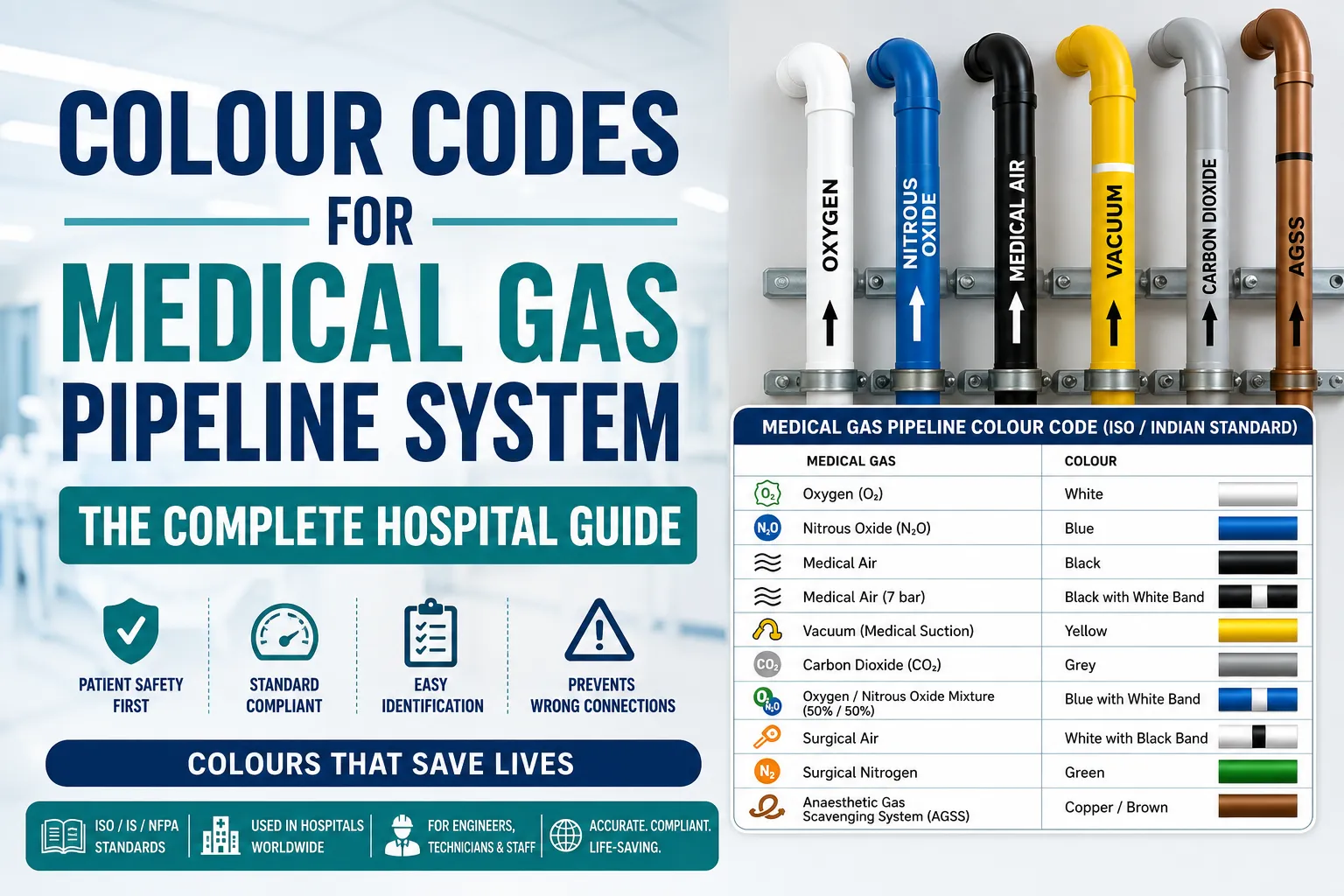

Colour Codes For Medical Gas Pipeline System: The Complete Hospital Guide
Walk into any hospital corridor and look up at the ceiling. You will spot rows of copper pipes running along the walls, each one painted or banded in a different shade. That is not decoration. That is the medical gas pipeline system (MGPS), and every colour on it is a life-saving signal. Get the medical gas pipeline colour code wrong during installation or maintenance, and you risk connecting a patient to the wrong gas. That is why the oxygen pipe colour in hospital settings, along with codes for nitrous oxide, medical air, vacuum, and carbon dioxide, follows strict national and global standards.
In this guide, we will break down the medical gases color codes used across India, the UK, and the US, explain the standards behind them (ISO 32, IS 2379, HTM 02-01, and NFPA 99), and give you ready-to-use charts you can actually reference on site. Whether you are a hospital engineer, a biomedical student, or someone just curious about that yellow pipe in hospital corridors, this article has you covered.
What Is a Medical Gas Pipeline System (MGPS)?
An MGPS is a network of pipes, valves, alarms, and outlets that carries medical gases from a central source (like a manifold, cylinder bank, or oxygen plant) straight to the patient's bedside, operation theatre, or ICU. It forms one of the most critical parts of overall hospital MEP systems planning, since gas pipelines share ceiling and wall space with electrical, plumbing, and HVAC networks and need to be coordinated carefully during design. Before this system became common, hospital staff had to wheel around heavy gas cylinders from bed to bed. That was slow, risky, and hard to manage during emergencies.
Today, a single MGPS network typically supplies:
- Oxygen (O2)
- Nitrous oxide (N2O)
- Medical air at 4 bar and 7 bar pressure
- Carbon dioxide (CO2)
- Oxygen/nitrous oxide mixture (50%/50%)
- Surgical air and surgical nitrogen (used to power pneumatic tools)
- Vacuum (medical suction)
- Anaesthetic gas scavenging systems (AGSS)
Each gas travels through its own dedicated pipeline. Mixing lines is never allowed, which is exactly why the medical gas pipeline colour code system exists in the first place.
Why Colour Coding In Hospital Gas Lines Actually Matters
Picture an anaesthetist reaching for an oxygen outlet during surgery. If that outlet or pipe is mislabeled, the outcome could be fatal within seconds. A clear colour code in hospital settings lets doctors, nurses, technicians, and even fire responders identify a gas line on sight, without reading a single label.
Here's what proper colour coding gives a hospital:
- Instant recognition during emergencies, when there is no time to check documents
- Fewer wrong-gas connections during servicing, renovation, or new installation work
- Compliance with fire safety and biomedical engineering audits
- Faster fault finding when a pressure drop or leak needs tracing
Because the stakes are so high, several standard-setting bodies around the world publish their own gas colour code requirements, and it helps to know which one applies where you work. Colour coding is usually just one part of a much broader hospital fire safety compliance plan, since gas pipelines, oxidizers, and pressurized systems are treated as fire hazards under most national building codes.
Which Standards Govern Medical Gas Colour Codes?
Depending on the country, one of these standards usually applies:
| Standard | Region | Covers |
|---|---|---|
| ISO 32:1977 (and later revisions under ISO/FDIS 32) | International reference standard | Colour coding for gas cylinders used in medical applications |
| IS 3016 & IS 2379 | India | Design, installation, and colour marking of piping systems and medical gas pipelines |
| IS 7396 | India | Design and installation of MGPS networks |
| HTM 02-01 & BS EN ISO 7396-1 | United Kingdom / NHS facilities | Medical gas pipeline system design, installation, and operational management |
| NFPA 99 with CGA C-9 | United States | Health care facility gas and vacuum system labeling and colour marking |
India generally follows the ISO standard pipeline colour codes rather than the American system, so hospitals here should not confuse the two when reading imported technical documents.
Medical Gas Pipeline Colour Code Chart at a Glance
This infographic provides a quick visual reference to the most commonly used medical gas pipeline colour codes in hospitals. It highlights the ISO/Indian standard colours for oxygen, nitrous oxide, medical air, vacuum, carbon dioxide, AGSS, and other medical gases, along with their typical applications. While the detailed tables later in this guide explain each gas and regional standards in depth, this chart is designed to help hospital engineers, biomedical professionals, contractors, and healthcare staff identify gas pipelines quickly during installation, maintenance, inspections, and emergency situations.
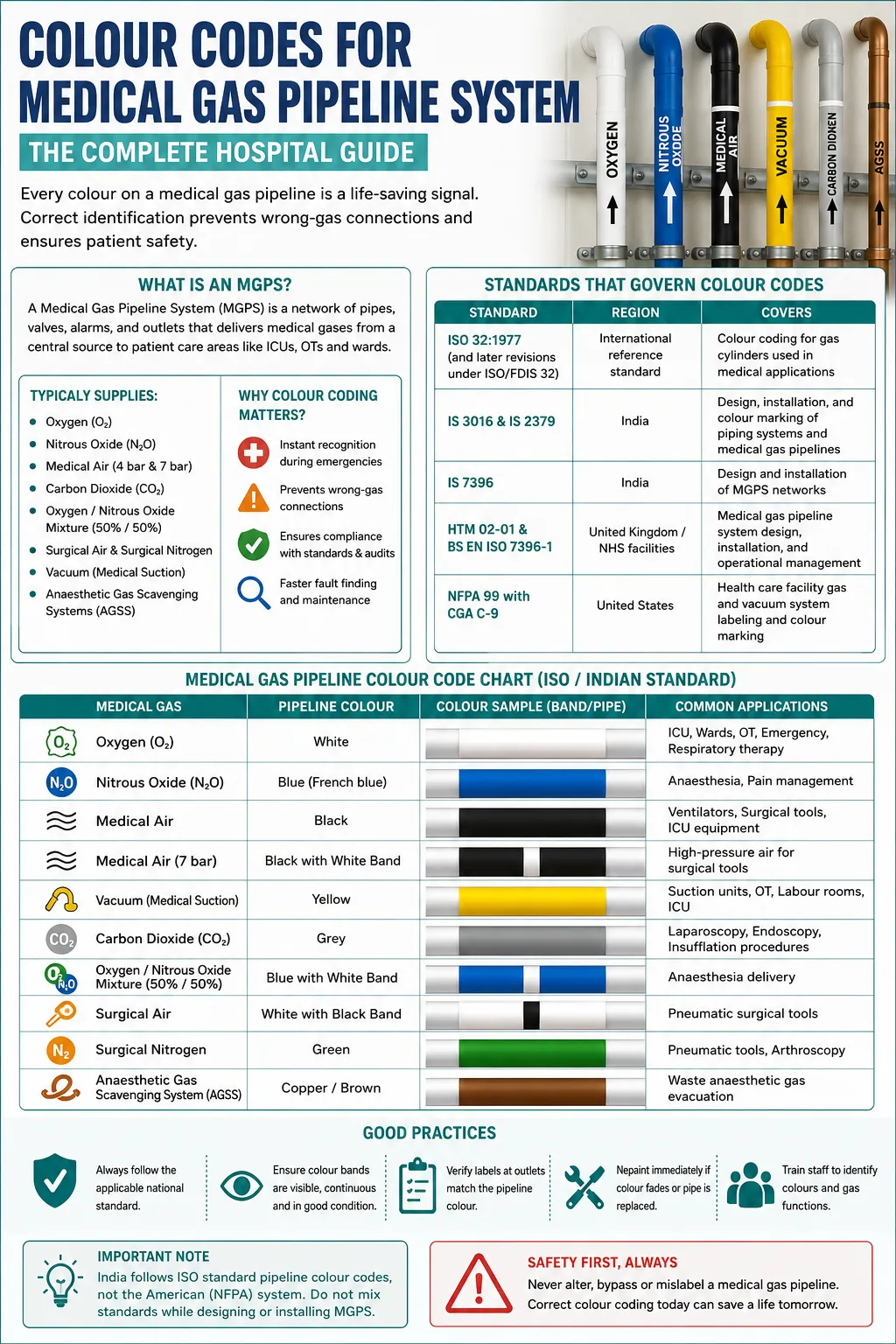
Medical Gas Pipeline Colour Code Chart (ISO / Indian Standard)
This is the chart most Indian hospitals, and many countries that follow ISO conventions, rely on for their medical gas pipeline colour code markings on copper piping.
| Medical Gas | Pipeline Colour |
|---|---|
| Oxygen (O2) | White |
| Nitrous Oxide (N2O) | Blue (French blue) |
| Medical Air | White and black stripes |
| Carbon Dioxide (CO2) | Grey |
| Oxygen/Nitrous Oxide Mixture | White and blue |
| Surgical/Instrument Air | White and black quartered |
| Vacuum | Yellow |
| Anaesthetic Gas Scavenging (AGSS) | Yellow with the letters AGS |
| Helium | Brown |
This is why you will often hear people ask specifically about the oxygen colour code. Under ISO 32, oxygen carries a white identity, both on the cylinder shoulder and on the pipeline itself, a detail that trips up a lot of people who assume oxygen should be green because that is the American convention.
Oxygen Pipe Colour In Hospital Settings
Since oxygen is the most widely used and most critical medical gas, its colour identity gets asked about the most. Under the ISO system followed in India, the oxygen cylinder colour in hospital settings and the pipeline colour are both white. Some technical documents also reference an older Indian practice where oxygen pipelines were painted yellow with white bands, so if you spot a yellow pipe in hospital ceilings during an older facility audit, check the local documentation before assuming it is a vacuum line, since older buildings sometimes used different conventions before ISO alignment became standard practice. This is exactly the kind of detail that gets scrutinised under NABH standards for OT, ICU, and emergency departments, where gas outlet identification is checked room by room.
Nitrous Oxide Colour Code
Nitrous oxide, the anaesthetic gas often called laughing gas, is always blue under ISO conventions. This nitrous code stays consistent across cylinders and pipelines. Because nitrous oxide is only used through anaesthesia machines during surgery, its outlets appear almost exclusively in operation theatres and recovery areas, not general wards.
Medical Gas Cylinder Colour Code Chart
Pipelines are not the only place colour coding shows up. Portable medical gas cylinders follow their own medical gas cylinder colour code chart, and technicians need to know both systems since hospitals often run cylinders as a backup supply to the piped network.
| Gas | Cylinder Body Colour (ISO 32) |
|---|---|
| Oxygen | White |
| Nitrous Oxide | Blue |
| Medical Air | Black and white shoulder |
| Carbon Dioxide | Grey |
| Helium | Brown |
| Oxygen/Helium Mixture | White and brown |
| Oxygen/Nitrous Oxide Mixture | White and blue |
It's worth knowing that some countries still run older or hybrid colour systems for cylinders. Thailand, for example, uses emerald green for oxygen cylinders, while the older UK convention used black bodies with white shoulders for oxygen before shifting fully to white bodies under BS EN 1089-3. So a medical gas cylinder colour code chart is only accurate for the region it was written for. Always confirm which national standard your facility follows before repainting or relabeling any cylinder.
US Colour Code: NFPA 99 and CGA C-9
If you work with American-built hospitals, imported equipment, or NFPA-certified facilities, you will run into a completely different medical gas color code system. The United States follows NFPA 99 for labeling requirements and CGA C-9 for the actual colour combinations. Unlike ISO, oxygen is green here, not white.
| Gas / System | Background Colour | Text Colour |
|---|---|---|
| Oxygen | Green | White (or reversed) |
| Nitrous Oxide | Blue | White |
| Medical Air | Yellow | Black |
| Carbon Dioxide | Grey | Black or white |
| Nitrogen | Black | White |
| Helium | Brown | White |
| Instrument Air | Red | White |
| Medical-Surgical Vacuum | White | Black |
| Waste Anaesthetic Gas Disposal (WAGD) | Violet | White |
This American gas pipe code also spells out non-medical variations. Non-medical air, for instance, uses a yellow and white diagonal stripe with black text, keeping it visually distinct from the medical-grade version so a technician never accidentally connects patient equipment to a lab or workshop air line.
ISO vs US: Quick Colour Code Comparison
People setting up multinational hospital chains or comparing an iso standard piping color codes chart against American documentation often get confused by how differently the two systems treat the exact same gas. Here's a side-by-side comparison for the most commonly asked gases.
| Gas | ISO / Indian Standard | US (NFPA 99 / CGA C-9) |
|---|---|---|
| Oxygen | White | Green |
| Nitrous Oxide | Blue | Blue |
| Medical Air | White and black stripes | Yellow |
| Carbon Dioxide | Grey | Grey |
| Vacuum | Yellow | White |
| Helium | Brown | Brown |
Notice that nitrous oxide, carbon dioxide, and helium line up between both systems, but oxygen, medical air, and vacuum flip almost entirely. This mismatch is precisely why importing pipe markers or training manuals from a different country without checking the local standard can create dangerous confusion on site.
Pipeline Installation and Central Line Colour Coding Rules
Colour coding is not just about painting a pipe once and forgetting about it. Standards like IS 2379 and HTM 02-01 lay out exactly how the marking should be applied across the entire central line colour coding network, from the main riser down to the smallest branch outlet.
General Placement Rules
- Colour bands or full pipe painting should be applied along the entire visible length wherever practical.
- Markings must repeat at regular intervals, typically every few metres, so a technician never has to walk far to confirm a pipe's identity.
- Labels and colour bands must appear near valves, joints, wall penetrations, and direction changes.
- Where pipes sit above normal eye level, lettering should be placed below the horizontal line of the pipe so it stays readable from the floor.
- Flow direction arrows are required on vacuum and WAGD lines to show which way the gas or suction is traveling.
Valve Boxes and Alarm Panels
Every zone valve box and area alarm panel in the MGPS network needs its own labeling that states the gas name, its colour code, and the exact rooms or wards it serves. A caution notice is also required, warning staff not to operate the valve except during an actual emergency or scheduled maintenance shutdown. This detail matters because a single mislabeled valve box can shut off oxygen to an entire ward during unrelated repair work elsewhere in the building. Verifying every valve box, alarm panel, and outlet label is usually one of the final steps in a proper hospital commissioning checklist before a facility goes live.
Common Medical Gases and Their Uses In an MGPS Network
| Gas | Primary Clinical Use | Typical Location |
|---|---|---|
| Oxygen | Respiratory support, ventilators, anaesthesia machines | Wards, ICU, operation theatres, emergency rooms |
| Nitrous Oxide | Anaesthetic and analgesic during surgery | Operation theatres only |
| Medical Air | Respiratory therapy, ventilator drive gas | ICU, respiratory wards, NICU |
| Carbon Dioxide | Laparoscopic and minimally invasive surgery | Operation theatres |
| Surgical Air/Nitrogen | Powering pneumatic surgical tools | Operation theatres, orthopaedic suites |
| Vacuum | Patient suction, anaesthetic gas scavenging | Wards, ICU, operation theatres |
Why Getting the MGPS Colour Code Right Is Non-Negotiable
A hospital's mgps in hospital network runs around the clock. Unlike most building services, this one cannot go down without putting lives at direct risk. That is why regulatory bodies keep tightening documentation requirements around pipeline colour marking, testing, and commissioning. Every biomedical engineer, contractor, and hospital administrator involved in planning a new facility or upgrading an old one needs a working knowledge of the applicable pipe line colour code, not just a general idea of it.
If your facility is being newly built or retrofitted, get the colour coding checked against the current version of your national standard before the pipes are sealed behind walls or ceilings. Fixing a mislabeled pipe after installation is expensive and disruptive, while getting it right the first time takes almost no extra effort during construction. This is one of the many technical details a specialised hospital project consultancy team checks during design review and site inspection, well before contractors move on to finishing work.
Conclusion
Colour codes on a hospital's gas pipelines look simple on the surface, but they carry enormous weight in patient safety. Whether you are checking the oxygen pipe colour before connecting a ventilator, tracing a gas line color during a maintenance round, or comparing an iso standard piping color codes chart against a US-built facility's documentation, getting the code right is not optional. India generally follows the ISO and IS 2379 system where oxygen is white and vacuum is yellow, while the US follows NFPA 99 and CGA C-9 where oxygen is green and medical air is yellow. Knowing which standard applies to your building, and applying it consistently across pipes, valve boxes, and alarm panels, is one of the simplest ways a hospital protects both its staff and its patients every single day, and it also makes the entire NABH accreditation process far smoother when auditors arrive.
Let’s Build Your Dream Hospital
Whether you’re planning a new hospital, expanding an existing facility, or upgrading your healthcare technology, Actiss Healthcare is here to guide you every step of the way. Let us help you turn your vision into reality. Contact us today for a free consultation & learn more about our services and how we can support your next healthcare project.

Frequently Asked Questions
1. What colour is the oxygen pipe in a hospital?
Under the ISO and Indian standard, oxygen pipelines and cylinders are white. Under the US NFPA 99 and CGA C-9 system, oxygen is coded green instead.
2. What colour is used for nitrous oxide pipelines?
Nitrous oxide is coded blue under both the ISO system and the US NFPA 99/CGA C-9 system, making it one of the few gases where the two standards actually agree.
3. Why is the vacuum line yellow in some hospitals?
Under the ISO and Indian standard, medical vacuum pipelines are marked yellow. This helps staff instantly separate suction lines from gas supply lines, since accidentally connecting a device to vacuum instead of a gas outlet, or the reverse, can be dangerous.
4. Which standard should Indian hospitals follow for MGPS colour coding?
Indian hospitals generally follow IS 3016, IS 2379, and IS 7396 for pipeline design and colour marking, alongside the international ISO 32 reference for cylinder colours. HTM 02-01 is also commonly referenced for operational management guidance, especially in facilities influenced by UK healthcare design practices.
5. Is the colour code the same for gas cylinders and gas pipelines?
Largely yes under the ISO system, since oxygen, nitrous oxide, carbon dioxide, and helium keep the same colour identity whether they are in a cylinder or running through a fixed pipeline. Medical air is the main exception, since it often appears as plain black and white stripes on pipelines but as a black and white shoulder marking on cylinders.
6. What happens if a medical gas pipe is colour coded incorrectly?
An incorrect colour code raises the risk of a wrong-gas connection, which can lead to equipment failure, patient injury, or worse during surgery or intensive care. It also creates compliance issues during hospital safety audits and can delay accreditation processes like NABH certification.