
Oncology Hospital Planning: Infrastructure Requirements for Cancer Care
Planning an oncology hospital is nothing like planning a general hospital. Cancer care is one of the most clinically complex, technically demanding, and emotionally charged areas of medicine - and the physical infrastructure has to reflect all of that. From radiation therapy bunkers buried in reinforced concrete to calming infusion bays with natural light, every square foot of an oncology facility has a job to do.
Whether you're a healthcare administrator, architect, or hospital development professional, this guide walks you through the key infrastructure requirements that define a well-built cancer care facility. Let's get into it.
Why Oncology Hospital Planning Is Different
Cancer care is inherently multidisciplinary. A single patient's treatment plan can involve surgery, radiation, chemotherapy, imaging, pathology, palliative care, and psychosocial support, often all running concurrently. That means your facility has to house and connect a wide range of specialized departments in a way that supports smooth clinical workflows without making patients feel like they're navigating a maze.
On top of that, the setup requires significant investment in medical infrastructure, including advanced diagnostic imaging systems, radiation therapy units, surgical suites, and chemotherapy infusion centers. These aren't areas where you can cut corners or leave room for ambiguity in the hospital planning and designing phase.
The good news is that there's a solid body of evidence, regulatory guidance, and real-world best practices to draw from. Let's break it down department by department.
1. Radiation Therapy Infrastructure: The Most Technically Demanding Space
Radiation oncology is almost certainly the most technically complex part of your facility to design and build. It involves high-energy equipment that produces ionizing radiation, which means the structural and safety requirements are in a league of their own. If you want a deeper look at just this department, our guide on radiation oncology infrastructure design essentials covers it in full detail.
Radiation Bunkers and Shielding
The heart of any radiation therapy unit is the treatment bunker, a specially shielded room that houses the linear accelerator (LINAC). Linear accelerator bunkers require radiation protection that may include lead shielding and concrete walls, floors, and ceilings to specified thicknesses. The design of the bunker rooms may incorporate a maze entry to assist with radiation protection; a neutron door may also be required depending on the equipment selected.
Ideally, the bunkers are planned with 2.4-meter-thick walls and ceilings of concrete. High-density materials like concrete or steel should be used in walls, ceiling, and floor. A certified medical physicist must be brought in during the design phase to calculate exactly how much shielding is required based on the equipment type, energy levels, and workload.
Facilities are ideally designed with adjacent bunkers to reduce costs by sharing the primary shielding structures and, in so doing, minimize the footprint and the total volume of shielding material needed. This is a smart planning move, especially for facilities expecting high patient volumes. The IAEA's guide on radiotherapy facility master planning is one of the most thorough publicly available references for this type of structural planning.
Vault Design Options
Not all treatment vaults are built the same. The most suitable vault design can be determined by considering a facility's capacity and workflow. Vault design influences the size of door required as well as the thickness of the vault walls. Direct entry or mazeless vaults take up the least square footage but require more shielding and thicker walls. Mini-maze vaults add some square footage and reduce some of the shielding requirements. Maze configurations balance shielding and square footage requirements. Completely doorless vaults require additional square footage, but they remove the need for a door.
Here's a quick comparison of vault types to help you plan:
| Vault Type | Square Footage | Shielding Required | Door Required | Best For |
|---|---|---|---|---|
| Direct Entry (Mazeless) | Smallest | Highest | Yes (heavy) | Space-constrained facilities |
| Mini-Maze | Medium | Moderate | Yes | Balanced cost/space |
| Full Maze | Larger | Lower | Yes (lighter) | High-volume centers |
| Doorless | Largest | Lower | No | Patient flow optimization |
Zonal Planning for Radiation Oncology
A radiotherapy unit can be divided into a few transitional zones: a public zone comprising a reception area and a waiting area for family members; a patient zone consisting of a changing room and a patient waiting area before treatment; and a treatment zone where the patient receives radiotherapy, consisting of LINAC bunkers, brachytherapy, and a console or control room occupied by oncologists and technicians.
Sufficient parking should be made available for ambulances, staff, and patients. This sounds obvious, but it's consistently underestimated in facility planning, especially for cancer centers where many patients attend multiple times per week for extended treatment courses.
2. Chemotherapy Infusion Center Design
The chemotherapy infusion center is where many cancer patients spend hours at a time, often repeatedly over weeks or months. Getting this space right is as much about the patient experience as it is about clinical functionality.
Layout and Bay Configuration
According to the Centers for Disease Control and Prevention (CDC), approximately 650,000 U.S. cancer patients receive chemotherapy in outpatient oncology centers or clinics each year. That volume demands a thoughtful, well-organized infusion space. The environment itself plays a bigger role than most planners expect - research on how healing environments improve cancer care outcomes shows that design choices directly affect patient stress levels, treatment adherence, and overall satisfaction.
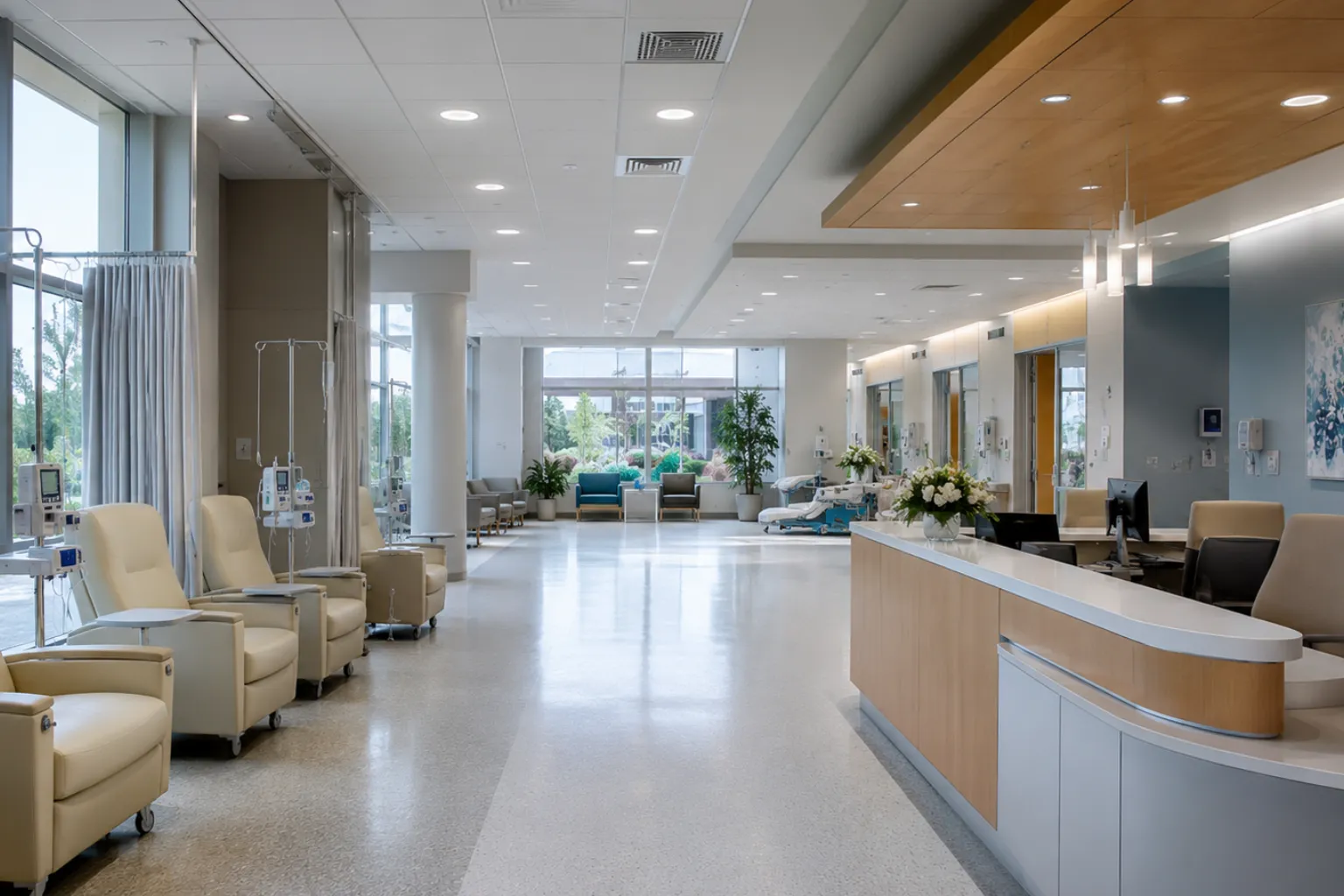
The layout of the infusion area should allow for private, semi-private, or open bays. The configuration of the bays should be around the windows to maximize patients' exposure to natural light and outside views. Visibility from the nurses' station is best when the bays are grouped in a circle around it. The bays should be equipped with ample electrical outlets at shoulder height, storage for personal belongings, a guest chair, and a TV or arm for portable devices.
An 84 square-foot infusion bay is a workable standard, equipped with a dedicated work surface, storage for efficient medication preparation and administration, and EMR charting capability. Hand-wash sinks located immediately adjacent to the treatment bays provide easy access to hand hygiene stations.
Oncology Pharmacy and Chemotherapy Compounding Room
The pharmacy is the backbone of a chemotherapy infusion unit, and it has very specific spatial and regulatory requirements.
Efficiency, sterility, and safety are fundamentals for oncology pharmacies. The clinical area needs to be located close to the infusion area, while the operation area needs to be near the receiving area. Within the clinical area, chemotherapy medication is prepared in the intravenous room and sent to the patient in the infusion area.
In-hospital chemotherapy services usually require two separate rooms: the chemo room, where the hazardous drugs are compounded, and the infusion area, where patients receive cancer medication. To be compliant, the chemo room needs to respect USP 800 guidelines. The chemotherapy cleanroom is kept under negative pressure to protect the pharmacist, the patients, and the environment from any harm due to the compounding of chemotherapy drugs.
Practically speaking, a typical compliant setup includes:
- An ISO 7-rated anteroom for staff gowning and decontamination
- An ISO 7-rated IV solutions cleanroom for sterile preparation
- A separate hazardous drug compounding room under negative pressure
- Non-porous, easily washable surfaces throughout all three areas
- Controlled HVAC for temperature, humidity, and airborne particle management
3. Surgical Oncology Suite Requirements
Surgical oncology covers a wide range of procedures, from relatively straightforward tumor excisions to highly complex resections involving multiple organ systems. The surgical suite in a cancer hospital has to be built to support this range.
Operating Room Specifications
Oncology operating rooms (ORs) generally need to be larger than standard ORs. A minimum of 600 to 800 square feet per OR is typical for complex oncological procedures, with additional space needed for robotic surgical systems. Integrated imaging capability, such as intraoperative CT or MRI access, is becoming standard in high-volume cancer centers and needs to be factored into the structural planning.
Key OR infrastructure requirements include:
- Laminar airflow ventilation systems to reduce surgical site infection risk
- Ceiling-mounted booms for gas, electrical, and data services to avoid floor clutter
- Radiation shielding if intraoperative radiation therapy (IORT) is planned
- Adequate corridor width (minimum 8 feet) for safe bed transport - a requirement that ties into broader hospital circulation planning across the entire facility
- Dedicated sterile processing department (SPD) with close proximity to the OR suite
4. Diagnostic Imaging: The Diagnostic Engine of Cancer Care
Imaging is involved at every stage of cancer management - screening, diagnosis, staging, treatment planning, response assessment, and surveillance. Diagnosis capabilities and treatment resources are key areas that must be assessed in the development of any comprehensive oncology strategic plan.
Core Imaging Modalities and Space Planning
A comprehensive cancer center should plan for the following imaging modalities and their corresponding infrastructure needs:
| Modality | Key Infrastructure Requirement | Shielding Needed | Approx. Room Size |
|---|---|---|---|
| CT Scanner | High floor load capacity, power supply | Yes (radiation) | 400–600 sq ft |
| MRI | RF shielding, magnetic field zoning, quench pipe | RF shielding | 600–900 sq ft |
| PET/CT | Hot lab for radiotracer preparation, decay room | Yes (radiation) | 600–800 sq ft |
| Digital Mammography | Privacy, natural light, calm patient environment | Yes (radiation) | 150–200 sq ft |
| Nuclear Medicine | Radiopharmacy, decay waste storage | Yes (radiation) | Variable |
MRI placement within the building requires particular care. The magnetic field it generates can interfere with nearby electronic equipment, pacemakers, and ferromagnetic materials. A certified MRI site planner must be involved early in the design process. For the technical side of integrating MRI with your digital systems, the guide on MRI integration with PACS and EMR systems is worth reading before you finalize equipment decisions.
Let’s Build Your Dream Hospital
Whether you’re planning a new hospital, expanding an existing facility, or upgrading your healthcare technology, Actiss Healthcare is here to guide you every step of the way. Let us help you turn your vision into reality. Contact us today for a free consultation & learn more about our services and how we can support your next healthcare project.

5. Pathology and Laboratory Services
Cancer diagnosis is built on tissue. A well-equipped pathology department, including histopathology, immunohistochemistry, molecular diagnostics, and cytology, is non-negotiable for any serious cancer center.
The lab infrastructure must support:
- Gross examination rooms with ventilated workstations for formalin handling
- Tissue processing, embedding, and sectioning areas
- Dedicated molecular pathology space with PCR and sequencing equipment
- Tumor biobanking capabilities, including cryogenic storage
- Rapid frozen section capabilities with direct communication lines to the OR
- Pneumatic tube systems or dedicated specimen transport routes to minimize delays
6. Inpatient Oncology Ward Design
Inpatient cancer units serve patients who are acutely unwell, often immunocompromised, and requiring close monitoring. The ward design has to balance infection control, clinical safety, and patient wellbeing.
Room Configuration and Infection Control
Single-occupancy rooms with private bathrooms are the gold standard for oncology inpatient wards, particularly for patients undergoing bone marrow transplants or intensive chemotherapy regimens that cause severe immunosuppression. HEPA-filtered positive pressure rooms are required for bone marrow transplant (BMT) units to protect these highly vulnerable patients from airborne infections.
Ward design considerations include:
- Single rooms as the default (not shared bays)
- Anteroom entry for BMT/stem cell transplant patients
- Handwash sinks at or near every room entrance
- Wide doorways (minimum 44 inches) for bed, IV pole, and equipment access
- Space for family members to stay overnight where possible
- Access to natural light and views of nature, which research consistently links to improved patient outcomes
7. Palliative Care and Supportive Services
Modern oncology facilities treat the whole patient, not just the tumor. Palliative care, psycho-oncology, social work, nutrition, physiotherapy, and spiritual care are all part of comprehensive cancer management, and they all need dedicated physical space.
Palliative care suites ideally have a residential feel rather than a clinical one. Private rooms with space for family, access to gardens or outdoor areas, and reduced noise levels all matter significantly to patients at this stage of care. A palliative care suite should feel fundamentally different from a standard ward.
8. Structural and MEP (Mechanical, Electrical, Plumbing) Requirements
Beyond the clinical departments, several building-wide infrastructure systems need special attention in an oncology facility. For a full breakdown of what goes into hospital MEP planning, our dedicated guide on hospital MEP systems planning is a useful companion to this section.
Power Systems
Radiation therapy equipment, MRI systems, and CT scanners require stable, dedicated power supplies with clean power conditioning. An uninterruptible power supply (UPS) and a backup generator system must be sized to cover all critical clinical areas, including the radiation therapy unit, intensive care areas, and operating theaters.
HVAC and Infection Control
The HVAC system in an oncology hospital is more complex than in a general hospital because of the mix of positive pressure (immunocompromised patient rooms) and negative pressure zones (chemotherapy compounding, isolation rooms). These zones must be physically separated with appropriate air pressure differentials, and the system needs to be validated during commissioning.
Waste Management
Cancer hospitals generate significant volumes of hazardous waste, including cytotoxic drug waste, radioactive waste from nuclear medicine, and biohazardous materials. A dedicated waste management infrastructure, including separate collection, storage, and disposal streams for each waste type, must be built into the facility from the beginning.
9. Patient Flow and Wayfinding
Early engagement of an architectural practice experienced in developing both concept designs and detailed plans for cancer centers is critical to ensuring that the facility truly answers as many clinical, patient, research, and operational requirements as possible. It allows stakeholder engagement to be integrated into the design process from the outset.
Patient flow through an oncology hospital is unique because many patients visit multiple departments in a single visit. A patient might have blood tests, see their oncologist, attend a radiation therapy session, and pick up prescriptions - all on the same day. Wayfinding must be intuitive, with clear signage, logical department adjacencies, and short travel distances between frequently linked services. There's a lot of practical guidance available on patient flow optimisation in hospital design that applies directly to oncology facility planning.
10. Technology Infrastructure and Digital Systems
Modern cancer care runs on data. The digital infrastructure of your facility is as important as the physical one.
Key technology infrastructure requirements include:
- An Oncology Information System (OIS) integrated with the hospital's electronic health record (EHR)
- A Picture Archiving and Communication System (PACS) with sufficient storage and display workstation capacity - see our full guide on PACS, EMR, and HIS systems for hospitals for procurement and integration advice
- Radiation therapy treatment planning software with dedicated, high-performance workstations
- Redundant network infrastructure with no single points of failure in critical clinical areas
- Teleoncology capabilities to support remote consultation and multidisciplinary tumor board meetings
- Patient entertainment and education systems in infusion bays and inpatient rooms
The design of flexible infrastructures can support hospitals to better and more quickly adapt to new technologies, keeping pace with the rapid evolution of healthcare. Building in structural flexibility, such as raised floor access, adequate riser capacity, and modular room configurations, means your facility won't be obsolete in a decade.
Conclusion
Building an oncology hospital is a genuinely complex undertaking that demands deep expertise across clinical planning, structural engineering, radiation physics, infection control, and patient-centered design. The departments and systems outlined above don't operate in isolation - they have to work together as one integrated clinical machine. Getting the infrastructure right means cancer patients receive better, safer, and more timely care. And that, ultimately, is the whole point.
Start planning early, bring in specialist consultants for radiation safety and medical equipment, involve clinicians throughout the design process, and build in flexibility wherever you can. The investment you make in rigorous planning pays back many times over in operational efficiency, staff satisfaction, and patient outcomes. If you're at the early stages of scoping your oncology facility, working with an experienced hospital project consultancy can help you avoid the most costly planning mistakes before they happen.
Let’s Build Your Dream Hospital
Whether you’re planning a new hospital, expanding an existing facility, or upgrading your healthcare technology, Actiss Healthcare is here to guide you every step of the way. Let us help you turn your vision into reality. Contact us today for a free consultation & learn more about our services and how we can support your next healthcare project.
Frequently Asked Questions (FAQs)
1. How thick do the walls need to be in a radiation therapy bunker?
Wall thickness depends on the type and energy of the equipment being used, but as a general planning benchmark, concrete walls of approximately 2.4 meters thick are commonly specified for LINAC bunkers. The exact specifications must be calculated by a certified medical physicist based on the specific equipment, workload, and occupancy of adjacent spaces. There's no one-size-fits-all answer here, which is why bringing in a radiation protection expert before finalizing structural drawings is critical.
2. What regulatory standards govern oncology pharmacy design?
In the United States, oncology pharmacies that compound hazardous drugs must comply with USP 800 guidelines, which set requirements for facility design, negative pressure rooms, HVAC systems, personal protective equipment, and waste disposal. USP 797 covers sterile compounding more broadly. Many other countries have equivalent national standards. Your pharmacy design must be reviewed by a qualified compounding pharmacist and a facility compliance specialist during the planning phase.
3. How many LINAC bunkers does a cancer center need?
The number of LINAC units required depends on your projected patient volume and the treatment modalities you plan to offer. As a rough guide, a single LINAC can treat approximately 25 to 30 patients per day in a standard workflow. Your facility's service plan and patient volume projections should drive this decision. Most medium-to-large cancer centers plan for a minimum of two LINACs to allow for equipment downtime without disrupting patient treatment schedules.
4. Should infusion bays be private or open plan?
This is genuinely a case-by-case design decision. Private rooms offer greater dignity and infection control advantages, but many patients actually prefer semi-private or open bay settings during chemotherapy infusions because they provide social connection and reduce anxiety. Research supports offering a mix of private, semi-private, and open bays so patients and care teams can choose what suits each individual best. All bay configurations should maximize access to natural light and outside views.