
Blood Bank Setup in India: Equipment, Infrastructure, Layout and Licensing
Thinking about starting a blood bank? It's one of the most useful healthcare projects you can take on, and one of the most tightly regulated. In India, human blood counts as a drug, so every unit you collect, test and issue falls under the Drugs and Cosmetics Act. This guide covers the blood bank equipment list, blood bank infrastructure requirements, blood bank licensing requirements in India, blood bank layout and design, and blood storage equipment requirements. Everything here comes from the official CDSCO guidelines and the Gazette of India. Let's get started.
Understanding the Rules Behind a Blood Bank
Whole human blood falls under the definition of a drug in the Drugs and Cosmetics Act, 1940. That's why blood banks are regulated under Part X-B of the Drugs and Cosmetics Rules, 1945, while the physical standards sit in Schedule F, Part XII-B.
One small update you should know about: a notification dated 11 March 2020 replaced the words "blood bank" with "blood centre" across these rules. Most people still say blood bank, so I'll use both terms here.
Blood Bank Licensing Requirements in India
Licensing is the first big step, so let's sort it out before you spend a rupee on equipment.
Who Can Apply for a Licence?
The 2020 amendment says applications come from blood centres run by the government, the Indian Red Cross Society, a hospital, a charitable trust or a voluntary organisation. Trusts and voluntary groups also need approval from the State or Union Territory Blood Transfusion Council. The National Blood Policy of 2002 also says fresh licences for stand-alone private blood banks should not be granted. A hospital-attached or trust-run model is therefore the realistic route, and it helps to understand who can legally open a hospital in India before you commit. Check the current position with your State Drugs Controller too.
Application, Forms and Fees
You apply to the State Licensing Authority in Form 27-C. The CDSCO guidelines list a licence fee of Rs 6,000 and an inspection fee of Rs 1,500. Fees can be revised, so confirm the current amount with your licensing office. Here's how the process runs:
- The State Licensing Authority verifies your application and inspects the premises.
- If satisfied, it forwards the report and application to the Central Licence Approving Authority, which is the Drugs Controller General of India.
- The central authority may carry out its own inspection, then grants or rejects the licence.
- A granted licence arrives in Form 28-C. Renewals use Form 26-G.
A licence stays valid for five years. If you apply for renewal after expiry but within six months, you pay an extra Rs 1,000 per month. If your application is rejected, you can appeal to the government within 30 days.
Documents to Attach
- A plan of the premises
- A list of machinery and equipment for collection, processing, storage and testing
- The memorandum of association or constitution of your organisation
- Certificates of education and experience for your technical staff
- Papers proving ownership or tenancy of the premises
Send a copy of the full application to the Central Licence Approving Authority and the local CDSCO zonal or sub-zonal officer too.
Conditions After You Get the Licence
Getting the licence is not the end of it. You must keep records and registers for five years, display the licence on the premises, report any change in technical staff straight away, and keep an Inspection Book in Form 35. You can never collect blood from a professional or paid donor.
A Smaller Option: Blood Storage Centre
If you only need to store blood for your own hospital, you may not need a full licence. Hospitals, community health centres, primary health centres and first referral units can apply for approval as a blood storage centre instead.
| Feature | Full Blood Centre | Blood Storage Centre |
|---|---|---|
| Licence | Form 28-C licence | Exempt, but needs state approval |
| Annual volume | No fixed cap | Up to 2,000 units |
| Minimum area | 100 sq m (plus 50 sq m for components) | 10 sq m |
| Validity | Five years | Two years |
| Blood source | Own collection | Licensed government blood bank, Red Cross or regional centre |
Blood Bank Infrastructure Requirements
Location and Building
Schedule F is clear on site selection. Keep the blood bank away from open sewage, drains, public lavatories and similar unhygienic surroundings. The building must stop insects, rodents and flies from getting in, and it should be well lit, ventilated and screened with mesh where needed. Walls and floors in collection and processing rooms must be smooth, washable and easy to keep clean. Drains need traps to prevent back siphonage. Staff also need clean overalls, head covers, footwear, gloves, and proper hand washing and toilet facilities. For a wider look at cleanable surfaces and airflow, read this guide on infection control in hospital design.
Staff You Must Hire
| Role | Key Requirement |
|---|---|
| Medical Officer (whole time) | MBBS with at least one year of blood centre experience, or MBBS with a pathology or transfusion medicine diploma plus short experience, or MD in Pathology or Transfusion Medicine |
| Blood Centre Technician | DMLT with one year of experience, or MLT degree, B.Sc. or M.Sc. in a relevant subject with six months of experience |
| Technical Supervisor (if you make components) | Similar qualifications as the technician, with experience in testing blood or components |
| Registered Nurse | Required |
| Counsellor or Medical Social Worker | Needed if you organise donation camps |
The exact headcount follows the Directorate General of Health Services Manual. You'll also need to train everyone in Good Manufacturing Practices and written Standard Operating Procedures, and keep records of that training.
Let’s Build Your Dream Hospital
Whether you’re planning a new hospital, expanding an existing facility, or upgrading your healthcare technology, Actiss Healthcare is here to guide you every step of the way. Let us help you turn your vision into reality. Contact us today for a free consultation & learn more about our services and how we can support your next healthcare project.

Blood Bank Layout and Design
The rules set a minimum of 100 square metres for operations, plus another 50 square metres if you prepare blood components. Within that space, you need separate rooms for specific jobs. The 2020 amendment added a counselling area and an identified quality control area.
| Room | Specification |
|---|---|
| Registration and medical examination | Furniture and facilities to register and screen donors |
| Blood collection | Air-conditioned |
| Component preparation | Air-conditioned, held between 20°C and 25°C |
| Blood group serology lab | Air-conditioned |
| Lab for transmissible diseases (hepatitis, syphilis, malaria, HIV) | Air-conditioned |
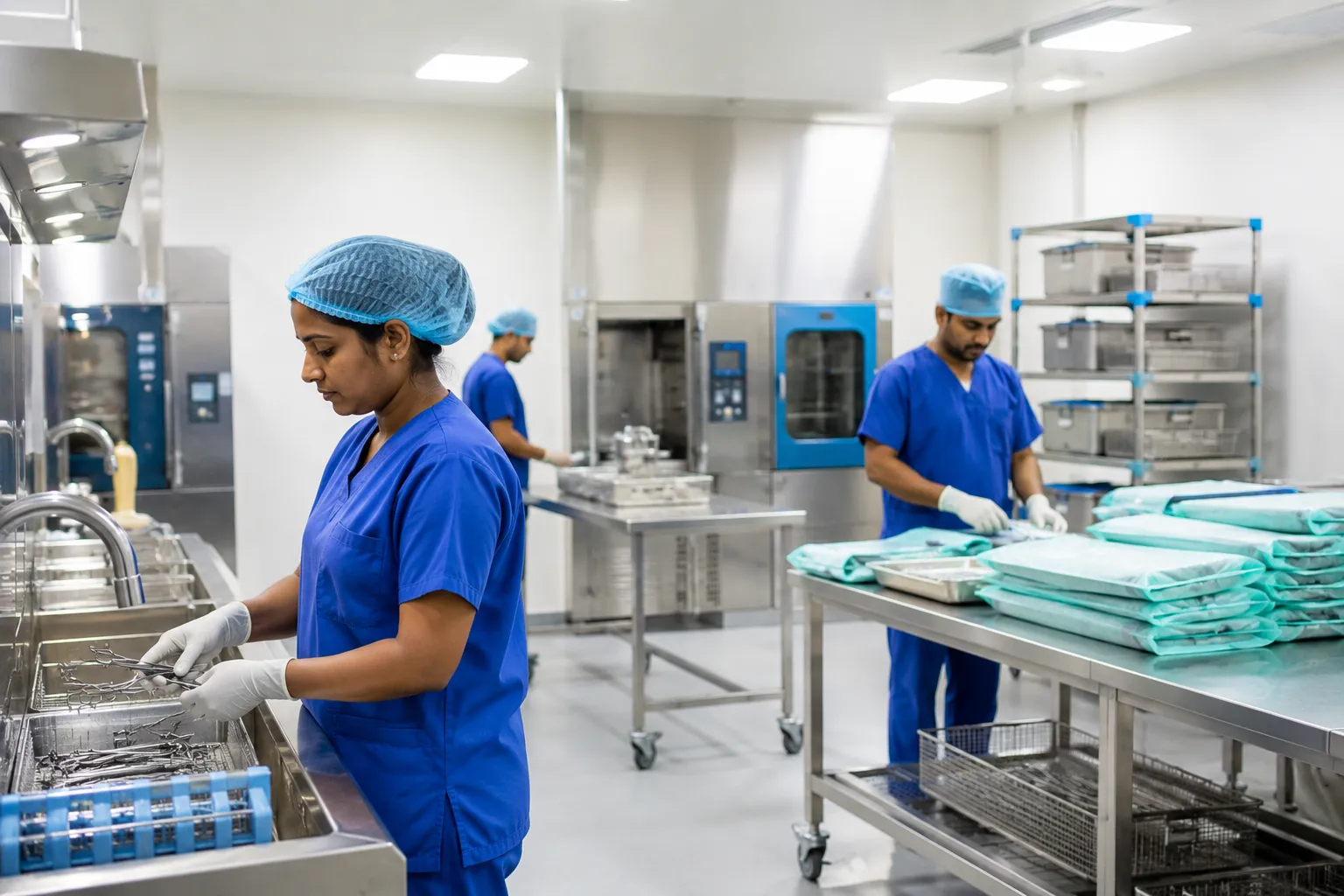
| Sterilisation and washing | Required |
| Refreshment and rest room | Air-conditioned |
| Store and records | Required |
| Counselling area | Adequate privacy |
| Apheresis area | 10 sq m, air-conditioned |
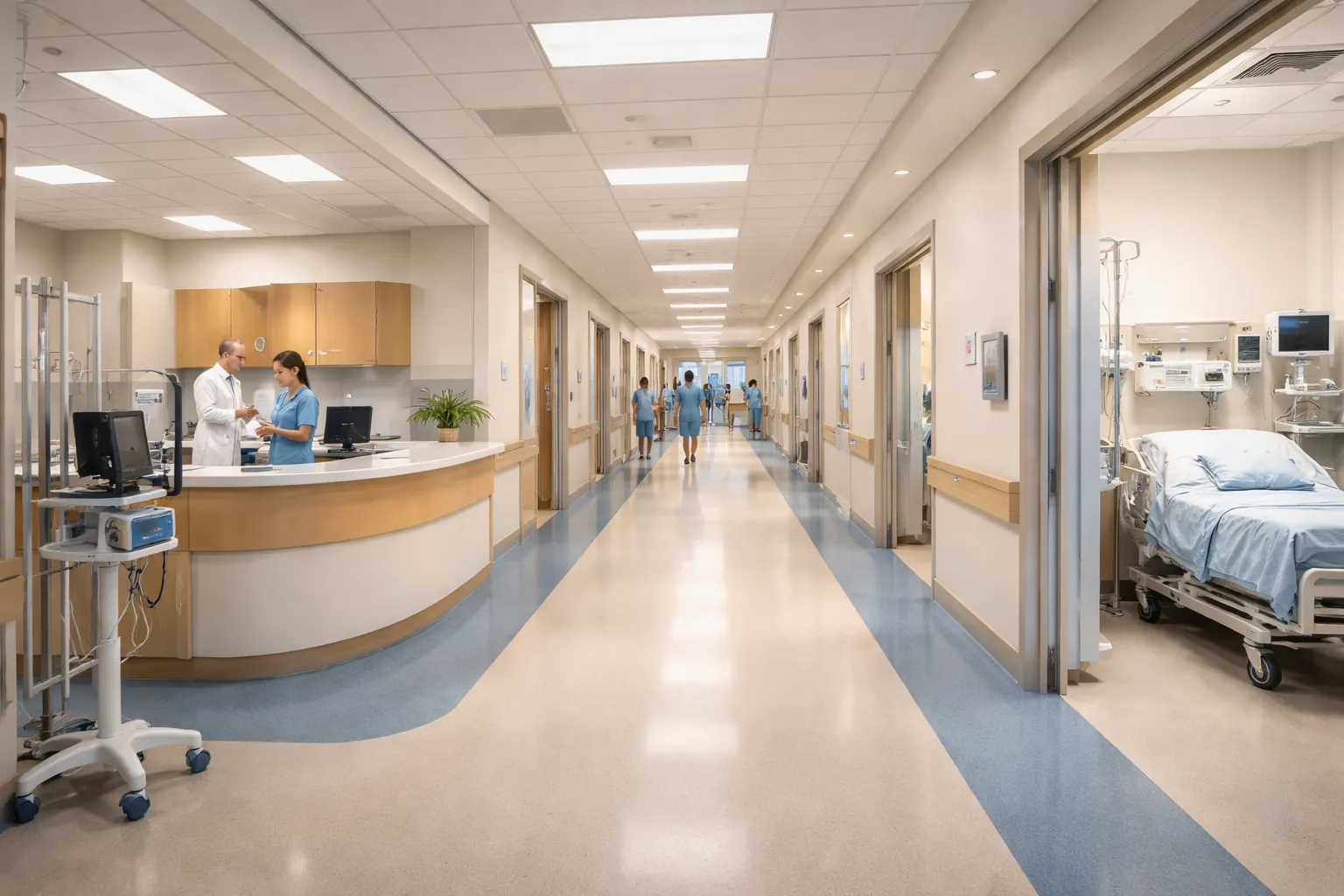
A smart blood bank layout and design follows the donor's path: registration, medical check, collection, then rest with refreshments. Donors must stay under observation in the blood bank after donation. If you want to see how movement is mapped on a floor plan, this piece on hospital floor plan layout and patient flow is a useful read. The rules also expect separate spots for quarantining untested blood, storing finished products and disposing of unsuitable units. If your blood bank sits inside a hospital that already has a pathology lab and a sterilisation room, the licensing authority may relax the area rules for those two spaces, with reasons recorded in writing.
Blood Bank Equipment List
Here's a practical blood bank equipment list taken straight from Schedule F, Part XII-B. If you're buying for a wider hospital project, this biomedical equipment procurement guide explains how to plan purchases step by step.
Blood Collection Room
- Cushioned donor beds, chairs and tables, plus bedside tables
- Recovery beds for donors
- Sphygmomanometer and stethoscope
- Weighing devices for donors and blood containers
- Closed-system disposable PVC blood bags with approved anticoagulant (CPDA-1 at 14 ml per 100 ml of blood)
- Haemoglobin testing supplies, such as copper sulphate solution, lancets, capillary tubes or a colorimeter
- Clinical thermometers and a watch with a seconds hand
Laboratory
- Reagent refrigerator (4°C to 6°C, plus or minus 2°C) with a digital thermometer
- Compound microscope and table-top centrifuge
- Water bath (37°C to 56°C) and thermostatic incubator
- Mechanical shaker for syphilis tests
- ELISA reader with printer, washer and micropipettes
- Dielectric tube sealer and insulated transport containers (2°C to 10°C)
- Glassware, pipettes, test tube racks, slides and an interval timer
Since 2020, labs can also use CLIA or ELFA equipment for infectious disease screening instead of ELISA.
Component Preparation
- Air conditioner and laminar air flow bench
- Refrigerated centrifuge
- Plasma expresser, automated extractor or multi head tube sealer
- Platelet agitator with incubator
- Deep freezers or snap freezers
- Refrigerated water bath for plasma thawing
- Cell separator, if you plan apheresis
Emergency and Support Items
- Oxygen cylinder with mask, gauge and regulator
- Sterile syringes, needles and IV sets, plus emergency injections
- Autoclave, incinerator and a standby generator
Blood Storage Equipment Requirements
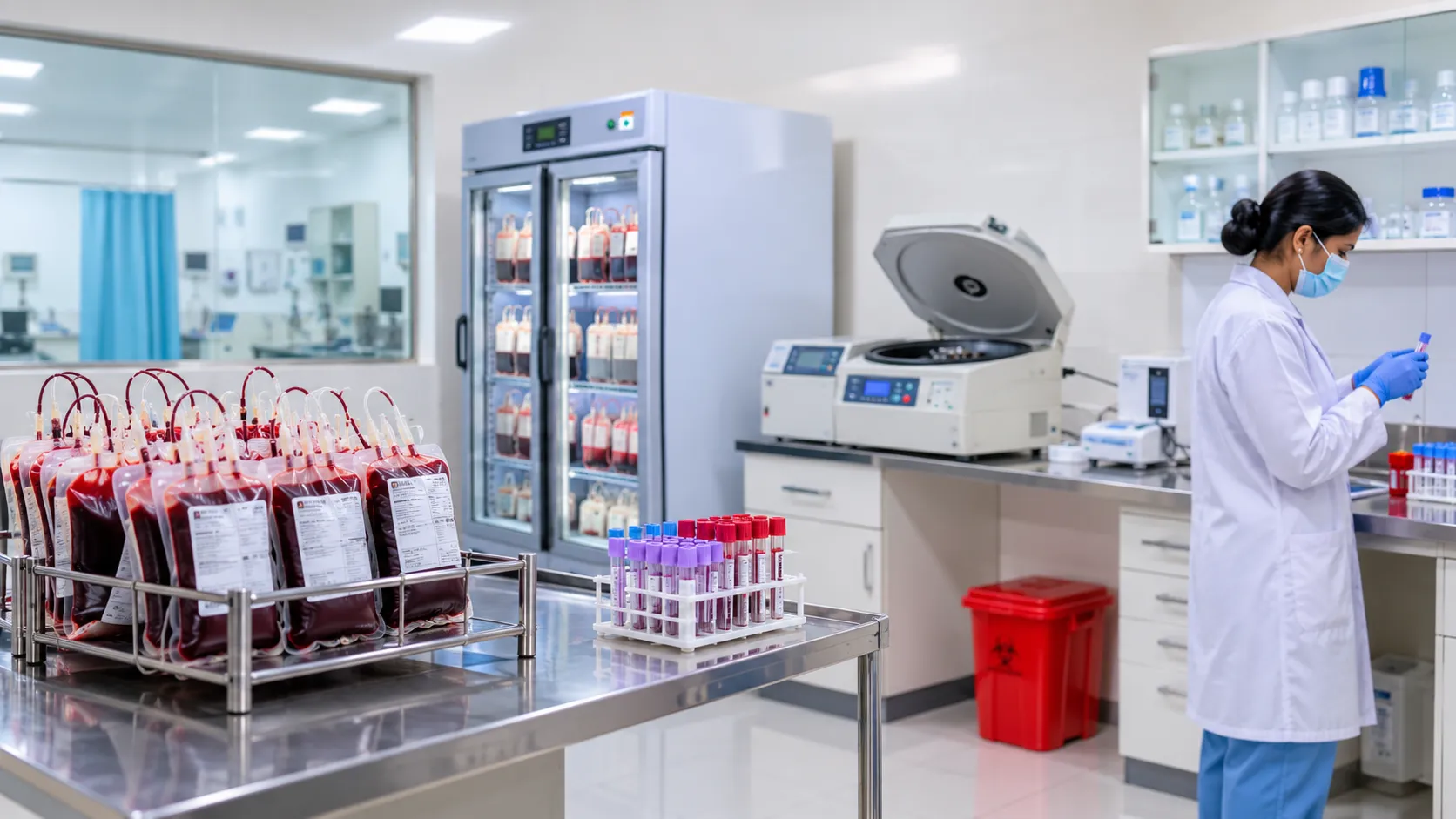
Blood storage equipment requirements are strict because a temperature slip can ruin a whole batch. Storage refrigerators need a digital thermometer, a recording thermograph, an alarm device and a continuous electricity supply. A tested backup system matters here, and this guide to hospital power backup planning covers the basics. Here are the storage conditions the rules lay down:
| Product | Storage Condition |
|---|---|
| Whole blood and packed red cells | 2°C to 6°C |
| Platelet concentrates | 20°C to 24°C with continuous agitation, up to 5 days |
| Fresh frozen plasma | Frozen within 6 hours, stored at minus 30°C or colder, up to one year |
| Cryoprecipitate | Minus 30°C or colder, up to one year |
| Granulocyte concentrates | 20°C to 24°C, up to 24 hours |
Never freeze blood meant for transfusion, and never let blood containers touch ice directly.
Calibration and Monitoring
Schedule F also sets checking schedules. Compare temperature recorders against a thermometer daily. Observe refrigerated centrifuges on each day of use. Check the haemoglobinometer, water bath and autoclave on each day of use. Test laboratory centrifuges with a tachometer every six months. Hematocrit centrifuges need standardising before first use, after repairs and every year. Standard certified weights are checked once a year.
Step-by-Step Plan to Set Up Your Blood Bank
- Confirm with your State Drugs Controller that your organisation type is eligible.
- Choose a hygienic site and plan at least 100 square metres (150 if you make components).
- Design the rooms using the layout table above.
- Hire a qualified Medical Officer, technicians and a nurse.
- Buy and install the equipment, then set up calibration records.
- Write your Standard Operating Procedures.
- File Form 27-C with all documents and fees.
- Prepare for state and central inspections.
Conclusion
Setting up a blood bank takes patience, but the rules are clear once you break them down. Start with eligibility and licensing, plan your layout around the required rooms, and buy equipment against the official list. Pay special attention to storage temperatures and staff qualifications, because inspectors check both closely. If you want expert help with planning, approvals and the building itself, hospital project consultancy support can make the process smoother. Do that, and your blood bank setup will be ready for a smooth licence process and, more importantly, for safe blood that patients can rely on.
Let’s Build Your Dream Hospital
Whether you’re planning a new hospital, expanding an existing facility, or upgrading your healthcare technology, Actiss Healthcare is here to guide you every step of the way. Let us help you turn your vision into reality. Contact us today for a free consultation & learn more about our services and how we can support your next healthcare project.
Frequently Asked Questions
1. How much space do I need for a blood bank in India?
You need 100 square metres for operations and an extra 50 square metres if you prepare blood components. Apheresis needs a separate 10 square metre air-conditioned area.
2. How long is a blood bank licence valid?
A licence in Form 28-C or a renewal in Form 26-G stays valid for five years unless it is suspended or cancelled earlier.
3. Who grants the blood bank licence?
The State Licensing Authority inspects and processes your application. The Central Licence Approving Authority, the Drugs Controller General of India, then approves it.
4. Can a hospital store blood without a full licence?
Yes, if it uses fewer than 2,000 units a year. It needs state approval, a 10 square metre area, a trained Medical Officer, a qualified technician and a licensed blood source. This approval lasts two years.
5. Which tests are mandatory on every blood unit?
Every unit must be tested for HIV I and II antibodies, Hepatitis B surface antigen, Hepatitis C antibody, syphilis (VDRL) and malaria parasites. Results go on the bag label.
6. How long must a blood bank keep its records?
Licensees must keep records and registers for five years. Donor and recipient blood samples must be preserved for seven days after issue.