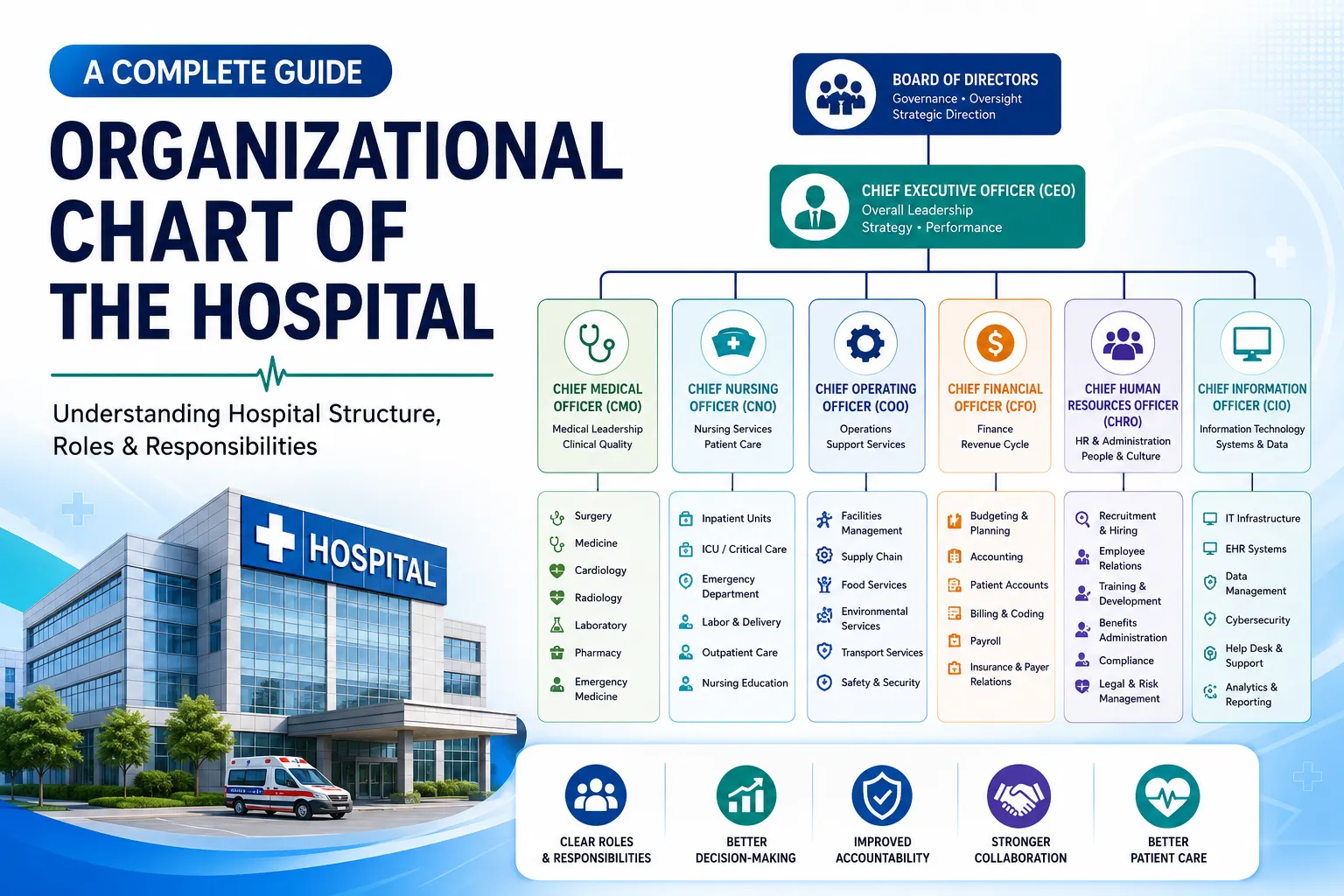

Organizational Chart Of The Hospital: A Complete Guide To Hospital Structure
If you've ever wondered who actually runs a hospital, you're not alone. Hospitals are some of the most layered workplaces around, with hundreds of roles working together to keep patients safe and departments running smoothly. That's exactly why a hospital organizational chart matters so much. It shows you, at a glance, who reports to whom, which department handles what, and how decisions travel from the top all the way down to the person changing your IV bag.
In this article, we'll break down the hospital organizational structure piece by piece. We'll look at the different types of hospital organogram formats, walk through each layer of the medical hierarchy chart, and show you real examples so you can build one for your own facility if needed. Let's get into it.
What Is A Hospital Organizational Chart?
A hospital organizational chart is a visual map that lays out the reporting relationships and departmental structure inside a healthcare facility. Think of it as a family tree, except instead of showing who's related to whom, it shows who answers to whom, from the governing board down to frontline staff.
Most hospitals organize their structure around three central pillars: patient care, medical staff, and hospital staff. The patient care component focuses on the direct care and support provided to patients during their hospital stay, including nurses, therapists, and technicians who work hands-on with patients. Medical staff refers to credentialed physicians, and hospital staff covers everyone else keeping the building and business running.
Why Every Hospital Needs A Clear Organizational Structure
Hospitals aren't like a small retail shop where three people can figure things out on the fly. A mid-size hospital might employ thousands of people across dozens of departments, and without a clear chain of command, things fall apart fast. Peter Drucker, the famous management thinker, once called a full-service hospital one of the most complex organizations in the world, and that's not an exaggeration once you count the number of specialties, shifts, and regulatory requirements involved.
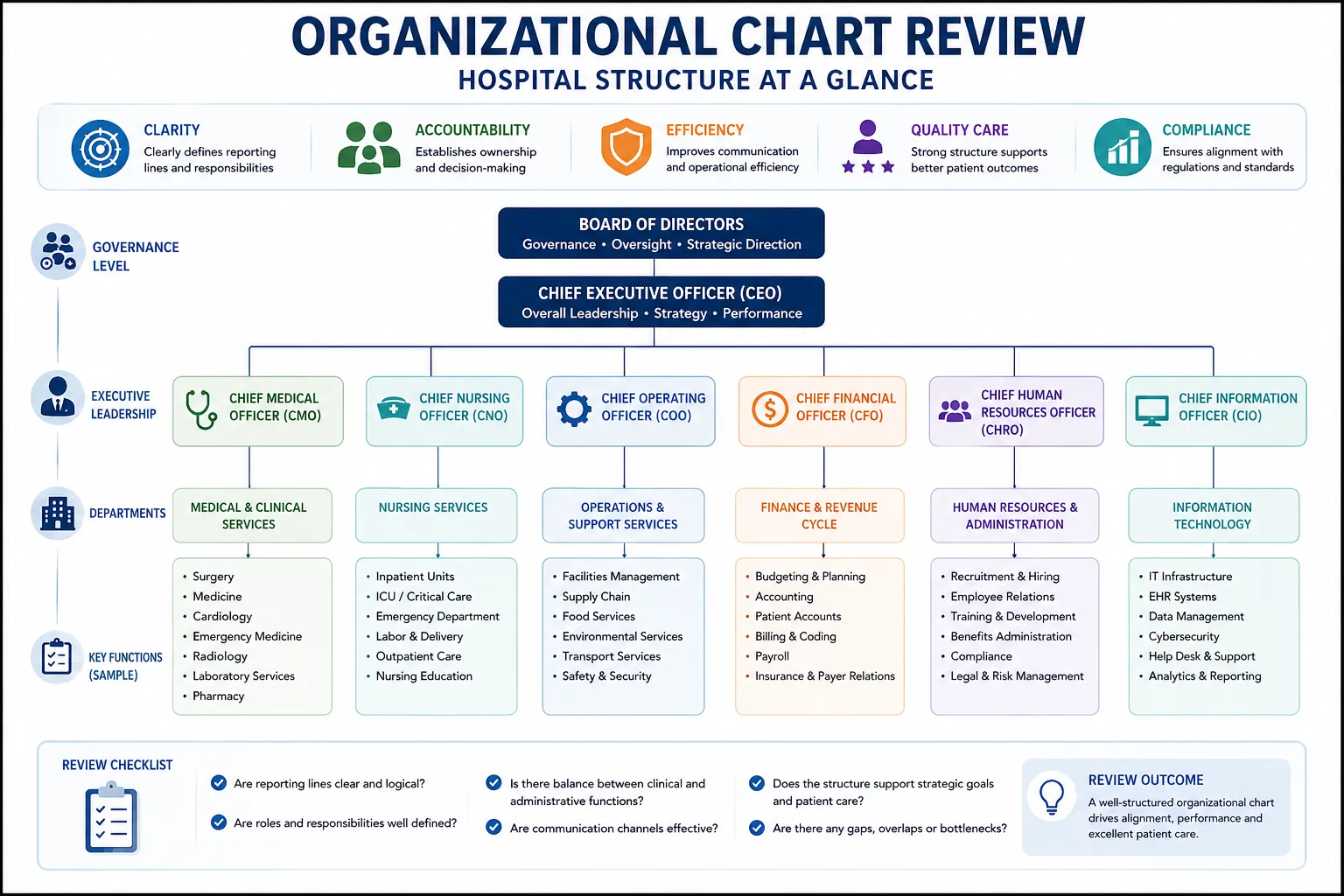
A well-built organizational structure of a hospital does a few things well:
- It clarifies who each employee reports to and who they can go to for specific issues
- It speeds up decision-making during emergencies
- It helps new staff understand the chain of command quickly
- It supports accountability across every shift and department
- It keeps administrative and clinical functions working side by side without stepping on each other
This becomes especially important for new hospital projects, where the founding team is essentially building the chain of command from a blank page. Getting the right people into the right roles early on, as covered in this guide on building the right team for a hospital project, tends to save a lot of restructuring pain down the line.
The Core Layers Of A Hospital Organizational Structure
Hospitals generally build their structure around three functional layers. Once you understand these, the rest of the chart makes a lot more sense.
1. Governance And Executive Leadership
At the top of most hospital org charts sits the board of directors, which provides fiduciary oversight, strategic direction, and compliance governance. In nonprofit hospitals, board members often include community representatives and physicians, while for-profit systems tend to include investors. Below the board is the CEO, who reports directly to it and carries the day-to-day responsibility for running the hospital, a reporting relationship explained in detail in Rivier University's overview of hospital organizational structure.
Right under the CEO, you'll typically find a leadership team made up of:
| Title | Primary Responsibility |
|---|---|
| Chief Executive Officer (CEO) | Overall strategy, board reporting, hospital-wide decisions |
| Chief Medical Officer (CMO) | Physician leadership, clinical quality, medical staff relations |
| Chief Nursing Officer (CNO) | Nursing staff, patient care standards, unit staffing |
| Chief Financial Officer (CFO) | Budgeting, billing, revenue cycle |
| Chief Operating Officer (COO) | Daily operations across departments |
| Chief Human Resources Officer (CHRO) | Staffing, hiring, employee relations |
2. Clinical Departments And Medical Staff
This is the part of the medical hierarchy chart most people picture when they think of a hospital. It includes physicians, surgeons, nurses, and specialists who deliver direct patient care. The level below top hospital leadership often includes surgeons, physicians, advanced practice registered nurses (APRNs), physician assistants, and registered nurses, a hierarchy that Tulane University's School of Public Health breaks down in more detail.
Further down that same branch, you'll find licensed practical nurses, nursing assistants, medical students, lab technicians, housekeepers, custodians, and medical records staff. Each clinical department, like surgery, radiology, or emergency medicine, usually has its own department head who reports up to the CMO or COO. A chief of surgery, for instance, oversees daily activities within the surgical department, performs surgery, and often handles public relations, fundraising, and recruitment for that department too.
3. Administrative And Support Functions
Administrative departments support clinical delivery but operate in parallel hierarchies, including finance, human resources, facilities, supply chain, compliance, information technology, and revenue cycle. These teams don't treat patients directly, but a hospital genuinely can't function without them. No IT team means no electronic health records. No supply chain team means no gloves, gauze, or medication on the shelves.
Let’s Build Your Dream Hospital
Whether you’re planning a new hospital, expanding an existing facility, or upgrading your healthcare technology, Actiss Healthcare is here to guide you every step of the way. Let us help you turn your vision into reality. Contact us today for a free consultation & learn more about our services and how we can support your next healthcare project.

Common Types Of Hospital Organizational Chart Structures
Not every hospital uses the same format. The right one depends on size, service mix, and how much cross-department collaboration is needed.
Hierarchical Structure
A hierarchical structure follows a top-down decision-making approach with clear reporting lines, where information flows down through levels of management. This is the most common type of hospital organizational structure chart, especially in large hospitals and health systems, because it makes roles and accountability crystal clear.
Functional Structure
A functional organization chart of hospital operations groups staff by their specific skill set and job function rather than by department location. Each function, such as nursing, radiology, or finance, is managed as its own unit with its own leadership line.
Flat Structure
Flat structures have fewer layers of management, allowing quicker decisions and more employee autonomy, though larger teams can end up with unclear reporting lines. Small clinics or rural hospitals often lean on this model simply because the team is small enough that everyone knows each other directly.
Matrix Structure
Matrix hospital organizational charts are used where departments work cross-functionally, which creates more complex connections and reporting relationships. This works well when specialists from different departments need to team up on complicated cases, such as oncology and radiology working together on a single patient's treatment plan.
Comparison Table: Hospital Structure Types
| Structure Type | Best Suited For | Main Advantage | Main Drawback |
|---|---|---|---|
| Hierarchical | Large hospitals and health systems | Clear chain of command | Slower decision-making |
| Functional | Hospitals with distinct specialty units | Deep expertise per function | Departments can work in silos |
| Flat | Small clinics, rural hospitals | Fast, informal decisions | Roles can get blurry as staff grows |
| Matrix | Hospitals needing cross-team projects | Strong collaboration between departments | Staff may report to two managers |
Typical Hospital Organizational Chart: Department Groupings
Hospital departments are almost never scattered at random. Grouping is generally done according to similarity of duties, and this arrangement helps promote efficiency across the facility. Here's how most healthcare organizational chart examples group things:
Administrative Services
- CEO and executive assistants
- Vice presidents and department heads
- Finance and billing teams
- Human resources
Informational Services
- Health information management / medical records
- IT and electronic health record systems
- Data privacy and compliance
Therapeutic Services
- Nursing units
- Physical and occupational therapy
- Pharmacy
- Surgical teams
Diagnostic Services
- Radiology and imaging
- Laboratory and pathology
- Cardiology diagnostics
Support Services
- Facilities and maintenance
- Housekeeping
- Food and nutrition services
- Security
How To Build An Organizational Chart For Healthcare Facility Use
If you're tasked with drafting one for your own facility, here's a simple approach that works for most hospitals, big or small.
- Gather actual reporting data. Pull real information from HR records instead of guessing at how departments are structured.
- Separate employees from contracted staff. Locum physicians, travel nurses, and consulting specialists often need dotted-line connections rather than solid reporting lines.
- Pick the right structure type. Match your hospital's size and complexity to hierarchical, functional, flat, or matrix formats. This decision usually ties back to the hospital's overall layout and workflow, which is why hospital planning and designing often happens alongside, not after, the org structure conversation.
- Account for span of control. A nurse manager might oversee 30 people across shifts, while a finance director might manage five. Getting this balance right prevents overload and keeps patient care from suffering.
- Set a review schedule. Staffing in hospitals changes constantly, so someone, usually HR, should own the chart and update it at least monthly.
Hospital Chain Of Command Chart: A Quick Example
Here's a simplified example of how a hospital hierarchy chart might look from top to bottom:
- Board of Directors
- Chief Executive Officer
- Chief Medical Officer / Chief Nursing Officer / Chief Financial Officer / Chief Operating Officer
- Department Heads (Surgery, Emergency, Radiology, Pharmacy, Finance, HR)
- Unit Managers and Supervisors
- Frontline Staff (Nurses, Technicians, Administrative Assistants, Support Staff)
This basic flow holds true across most hospitals, though the exact titles and layers shift depending on how big the facility is and whether it belongs to a larger health system. For hospitals still in the planning phase, mapping out this chain of command usually goes hand in hand with the broader feasibility study for a new hospital, since staffing needs directly affect budget and space planning.
Conclusion
Understanding the organizational structure of a hospital isn't just an exercise for HR teams or management students. It genuinely shapes how fast decisions get made, how well departments talk to each other, and how smoothly patients move through the system. Whether your facility runs on a hierarchical model, a matrix setup, or something in between, the goal stays the same: clear reporting lines, well-defined roles, and a structure that can hold up under the constant pace of hospital life. If you're building your own hospital organogram, start with real data, pick a structure that fits your size, and keep it updated as your team grows and changes. And if you'd rather have this mapped out by people who do it for a living, a look at best practices in hospital management is a good next stop.
Let’s Build Your Dream Hospital
Whether you’re planning a new hospital, expanding an existing facility, or upgrading your healthcare technology, Actiss Healthcare is here to guide you every step of the way. Let us help you turn your vision into reality. Contact us today for a free consultation & learn more about our services and how we can support your next healthcare project.
Frequently Asked Questions
1. What is the typical organizational structure of a hospital?
Most hospitals follow a hierarchical structure with a board of directors at the top, followed by the CEO, executive leadership (CMO, CNO, CFO, COO), department heads, and then frontline clinical and administrative staff.
2. Who is at the top of a hospital's chain of command?
The board of directors sits at the very top of the hospital chain of command chart, followed by the CEO, who manages daily operations and reports directly to the board.
3. What's the difference between medical staff and hospital staff on an org chart?
Medical staff refers to credentialed physicians who have been approved by the governing board to practice at the hospital. Hospital staff covers everyone else, including nurses, administrators, and support workers, who are typically direct employees.
4. Why do larger hospitals use a hierarchical structure instead of a flat one?
Larger hospitals have far more departments, staff, and regulatory requirements to manage, so a hierarchical structure keeps reporting lines and accountability clear, even if it means slightly slower decision-making.
5. What departments are usually grouped together on a hospital organizational chart?
Hospitals commonly group departments into five categories: administrative services, informational services, therapeutic services, diagnostic services, and support services.
6. How often should a hospital update its organizational chart?
Given how frequently hospital staffing changes, most experts recommend reviewing and updating the chart at least once a month, with continuous updates whenever roles or departments shift.