
Hospital Renovation Cost Per Square Meter: MEP, Civil and Fire Safety Breakdown
If you're planning a hospital renovation, one question dominates every planning meeting: how much is this actually going to cost? The honest answer is that hospital renovation costs per square meter are anything but simple. Unlike renovating an office building or a retail space, hospitals sit in a league of their own because of the complexity of their systems, the strictness of their codes, and the very real fact that patient safety hangs in the balance of every design decision.
In this article, we're going to break down the real numbers across three critical cost categories: MEP (Mechanical, Electrical, and Plumbing) systems, civil and structural works, and fire safety compliance. We'll look at what drives costs up, where you can find value, and what a realistic budget looks like heading into 2025 and 2026. If you're still in the early stages of project scoping, our guide on hospital MEP systems planning is a good place to start before you dive into numbers.
Why Hospital Renovation Costs Are So Different From Standard Commercial Projects
Let's start with the basics. Most commercial renovations fall between $500 and $2,000 per square meter depending on scope and location. Hospital renovations, however, consistently land at the higher end or well above that range. The reason comes down to what's inside the walls.
Hospitals carry an extraordinary density of specialized systems. You're looking at medical gas lines, surgical-grade HVAC with precise pressure relationships between rooms, redundant power systems, clean-agent fire suppression for sensitive equipment areas, and structural requirements that support heavy imaging machines. Stack all of that together, and you've got a project that's fundamentally more expensive per square meter than almost any other building type.
The scope of the renovation also matters a lot. A cosmetic refresh - new paint, updated flooring, refreshed lighting - is a completely different financial conversation than a full clinical renovation that rewires electrical systems, replaces HVAC infrastructure, upgrades plumbing, and brings fire systems into current code compliance. That distinction has to come first before any numbers make sense.
Overall Hospital Renovation Cost Per Square Meter: The Baseline
Before we break things down by system, here's a realistic starting point for hospital renovation costs per square meter in 2025 and 2026 across different scope levels.
| Renovation Scope | Cost Per Square Meter (USD) | What's Included |
|---|---|---|
| Cosmetic / Light Refresh | $500 – $1,100 | Paint, flooring, fixtures, minor electrical updates |
| Moderate Clinical Renovation | $1,100 – $2,500 | HVAC upgrades, plumbing rework, fire system updates, structural patching |
| Full Infrastructure Overhaul | $2,500 – $5,000+ | Complete MEP replacement, new fire safety systems, structural reinforcement, compliance upgrades |
| Specialized Units (ICU, OR, Radiology) | $4,500 – $9,000+ | Medical gas systems, laminar airflow HVAC, shielded rooms, specialized electrical |
Note: These figures are converted from U.S. per-square-foot data to per-square-meter (multiply by ~10.76). Actual costs vary significantly by geography, building age, and local labor market conditions.
MEP Systems: The Biggest Cost Driver in Hospital Renovation
What MEP Means in a Hospital Context
MEP stands for Mechanical, Electrical, and Plumbing - and in hospitals, these three categories are far more intensive than in any other building type. According to RSMeans construction cost data, MEP systems remain the dominant cost category in hospital construction and renovation, accounting for nearly one-third of total expenditure. When you're retrofitting or upgrading an existing facility, that percentage can climb even higher because you're working around existing infrastructure rather than starting fresh.
Mechanical: HVAC and Medical Gas
HVAC in a hospital isn't just about temperature comfort. It's a clinical tool. Operating rooms require laminar airflow to prevent surgical site infections. Isolation rooms need negative pressure to contain airborne pathogens. ICUs need tightly controlled humidity and air exchange rates. Hospital HVAC systems must maintain laminar airflow in ORs, negative pressure in isolation rooms, and precise temperature and humidity for sensitive medical equipment.
For a basic HVAC system in a clinical space, you're looking at roughly $160 to $215 per square meter. Specialized surgical or isolation environments push that number considerably higher. HVAC prices have remained elevated due to supply constraints and significant supply chain backlogs in mechanical, electrical, and plumbing categories. Factor in that medical gas systems - oxygen, nitrous oxide, vacuum lines - require their own dedicated installation by certified contractors, and the mechanical budget adds up fast.
Electrical: Power, Redundancy, and Data
Hospitals can't experience power interruptions. This means every renovation project must account for redundant electrical feeds, emergency generators, uninterruptible power supply (UPS) units for critical areas, and a complex distribution network. Hospitals must meet strict standards for system redundancy, air filtration, climate control, sanitation, and backup power, with specialized systems for patient safety driving up design and installation expenses.
Electrical renovation costs typically run $110 to $270 per square meter in clinical spaces, depending on the density of equipment, lighting requirements, and the complexity of the existing electrical infrastructure. Older hospital buildings often have undersized panels and outdated wiring that needs full replacement before new systems can be added.
Plumbing: Where Costs Have Been Rising Fast
Plumbing in hospitals covers patient bathrooms, clinical wash stations, surgical scrub sinks, sterilization rooms, and utility connections throughout the building. Plumbing accounts for up to 23.7% of material costs in hospital projects, and plumbing material costs jumped 8% to 9% in the last six months of 2025 alone. That's a significant jump that has hit renovation budgets hard, especially in multi-story facilities with extensive plumbing requirements on every floor.
Basic plumbing renovation work runs $160 to $320 per square meter. More intensive work involving new riser connections, complete fixture replacement, and backflow prevention systems will land at the higher end or beyond. Many project owners underestimate this scope - our article on hospital plumbing and water system design mistakes covers the most common errors that end up inflating renovation bills.
MEP Cost Summary Table
| MEP Subcategory | Typical Cost Per Square Meter (USD) | Key Factors |
|---|---|---|
| HVAC (Standard Clinical) | $160 – $215 | Air changes per hour, filtration grade, zoning |
| HVAC (OR / Isolation) | $430 – $860+ | Laminar flow, pressurization control, redundancy |
| Medical Gas Systems | $215 – $540 | Oxygen, vacuum, nitrous, anesthesia gas outlets |
| Electrical (Standard) | $110 – $215 | Panel upgrades, lighting, data/nurse call systems |
| Electrical (Critical Areas) | $215 – $540+ | UPS, generator tie-ins, isolated power systems |
| Plumbing (Standard) | $160 – $320 | Patient bathrooms, wash stations, utility connections |
Let’s Build Your Dream Hospital
Whether you’re planning a new hospital, expanding an existing facility, or upgrading your healthcare technology, Actiss Healthcare is here to guide you every step of the way. Let us help you turn your vision into reality. Contact us today for a free consultation & learn more about our services and how we can support your next healthcare project.

Civil and Structural Works: The Foundation of Any Hospital Renovation
Why Structural Costs Are Hard to Predict
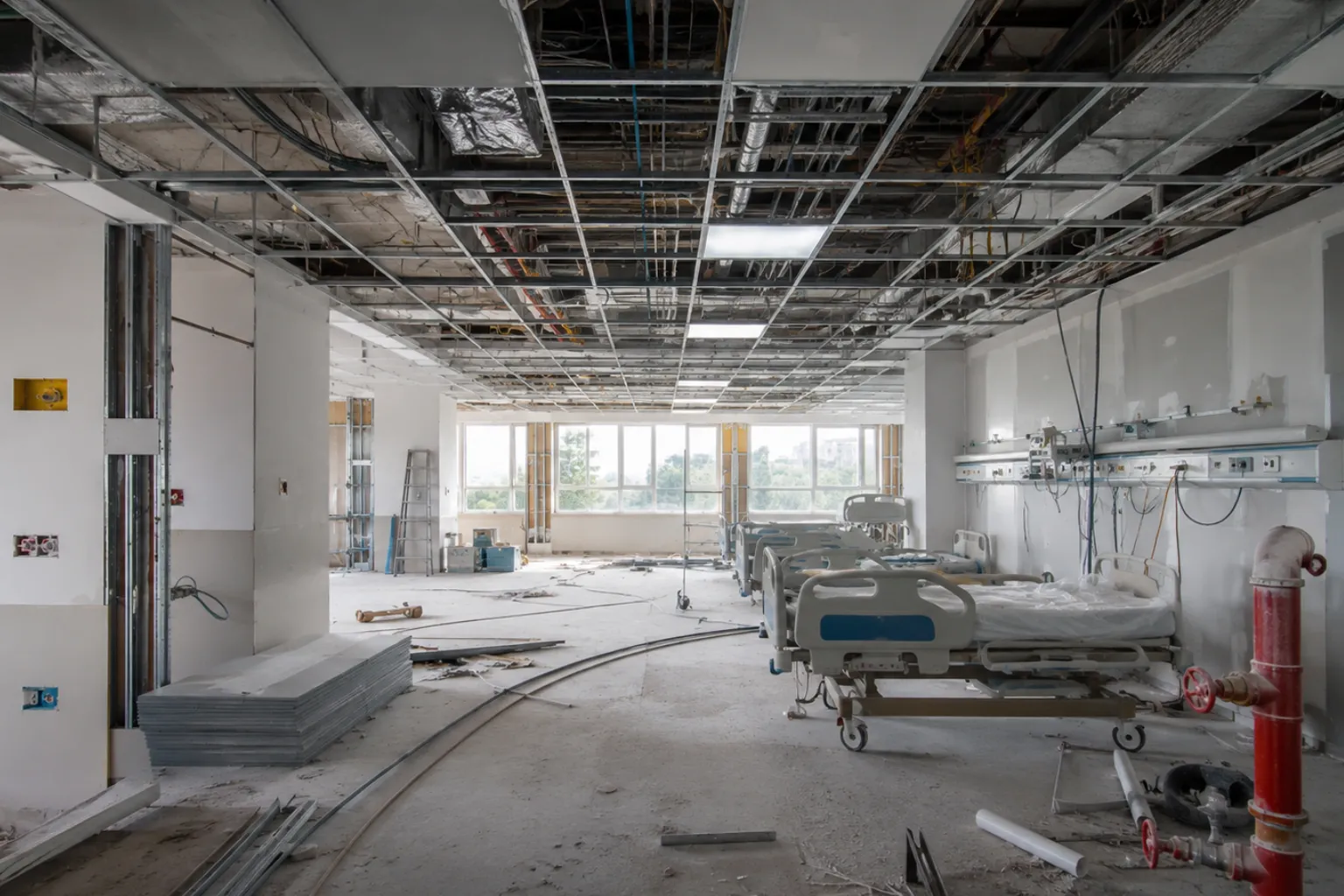
Civil and structural works in a hospital renovation cover everything from floor slab modifications and partition wall construction to roof repairs and facade updates. The challenge with structural costs is that they're deeply tied to the age and condition of the existing building. Older buildings typically have smaller structural bays that limit change, and lower floor-to-floor heights that constrict space for new or modified MEP systems. When important infrastructural components need to be redeveloped, they are often moved to the roof or different floors, affecting distribution or load handling and estimates of probable costs.
This is why pre-renovation assessments are so critical. A building that looks structurally sound on the surface can hide surprises once you open walls and ceilings: undersized beams that can't support new rooftop HVAC units, outdated concrete mixes, or water damage that has compromised structural integrity.
Structural Reinforcement for Heavy Equipment
One area that catches many hospital renovation budgets off guard is structural reinforcement for heavy medical equipment. MRI machines can weigh 4,000 to 10,000 kilograms. CT scanners, linear accelerators, and robotic surgery systems all require purpose-built structural supports, vibration isolation systems, and in the case of MRI, radiofrequency shielding. These scope items aren't optional, and they're expensive.
Civil Works Cost Breakdown
| Civil / Structural Category | Estimated Cost Per Square Meter (USD) |
|---|---|
| Partition walls and interior demising | $80 – $215 |
| Floor slab work and leveling | $65 – $160 |
| Structural reinforcement (general) | $110 – $325 |
| Structural support for heavy imaging equipment | $540 – $2,150+ |
| Ceiling systems (clinical-grade) | $55 – $160 |
| Flooring (clinical vinyl, epoxy, tile) | $55 – $215 |
| Exterior facade and envelope repairs | $215 – $540 |
| Seismic retrofitting (where required) | $215 – $860+ |
The Hidden Cost: Infection Control During Construction
Hospital renovations almost always happen inside occupied, operating facilities. This means contractors have to follow Infection Control Risk Assessment (ICRA) protocols at all times. Dust barriers, HEPA filtration on work areas, sealed off utility penetrations, and constant monitoring for airborne contamination all add cost and slow down work schedules. ICRA compliance alone can add 10% to 15% to civil works costs depending on the proximity of renovation zones to patient care areas.
Fire Safety Systems: Non-Negotiable and Increasingly Expensive
Why Fire Safety Is a Separate Line Item in Hospital Renovations
Fire safety in hospitals goes well beyond what you'd find in a standard commercial building. Hospitals have non-ambulatory patients who cannot evacuate quickly. This requires compartmentalized fire containment strategies, redundant alarm systems, specialized suppression solutions for high-value areas, and continuous smoke management. Upgraded safety features such as fire suppression, emergency lighting, infection control, negative-pressure rooms, and secure access are essential in hospitals and most often exceed the requirements for standard commercial buildings, with a direct impact on both cost and timeline. For a detailed look at what full compliance actually involves, see our hospital fire safety compliance guide.
Fire Sprinkler System Costs in Hospital Renovations
Retrofitting fire sprinklers into an existing hospital building is consistently more expensive than new construction. According to NFPA research data, new-construction sprinkler systems cost $1.50 to $3.00 per square foot, while retrofitting an older building typically runs $2.00 to $7.00 per square foot due to additional labor and materials. That translates to roughly $22 to $75 per square meter for new construction installations, and $22 to $75 per square meter climbing to $75 per square meter or more for retrofit work. In finished commercial properties, drywall removal, patching, and repainting after sprinkler installation can add $5 to $15 per square foot to the system cost.
For specialized hospital areas, the cost of fire suppression goes up further. Clean-agent systems protect MRI suites, data centers, pharmacy clean rooms, and server rooms where water would cause catastrophic damage to equipment. These systems carry costs of $22 to $65 per square meter just for the suppression agent delivery systems, not counting the monitoring and detection infrastructure around them.
Fire Alarm and Detection Systems
Hospital fire alarm systems are complex, zoned, and tightly integrated with HVAC controls, door hold-opens, elevator recall, and nurse call systems. In 2025, the average commercial fire alarm system costs range from $1 to $6 per square foot, including labor, devices, wiring, and control panel setup. A hospital or school with zoning complications might see prices as high as $60,000 or more for a single project.
Firestopping, Smoke Compartments, and Passive Protection
One of the most overlooked fire safety costs in hospital renovation is passive fire protection: firestopping at all MEP penetrations through rated walls and floors, smoke dampers in ductwork, rated door assemblies, and intumescent seals. Sprinklers, smoke compartments, and firestopping can form an interdependent safety strategy that requires coordination across multiple trades during renovation. Any change to a wall or ceiling during renovation can trigger a complete firestopping review of that compartment, which adds time and cost.
Fire Safety Cost Summary
| Fire Safety Component | Cost Per Square Meter (USD) |
|---|---|
| Wet pipe sprinkler system (new construction) | $16 – $32 |
| Wet pipe sprinkler system (retrofit) | $22 – $75 |
| Clean-agent suppression (specialty areas) | $22 – $65 |
| Fire alarm and detection (full hospital system) | $11 – $65 |
| Smoke dampers and HVAC integration | $11 – $32 |
| Firestopping and passive protection | $11 – $54 |
| Fire doors and rated assemblies | $1,080 – $3,230 per door |
How Renovation Scope Compares Across Different Hospital Areas
Not all parts of a hospital cost the same to renovate. An administrative wing renovation is nowhere near as intensive as upgrading an emergency department or a surgical suite. Here's how different zones typically compare:
| Hospital Area | Renovation Cost Per Square Meter (USD) | Key Cost Drivers |
|---|---|---|
| Administrative / Offices | $500 – $1,100 | Standard MEP, basic finishes |
| Patient Rooms (General Ward) | $1,100 – $2,700 | Medical gas, nurse call, HVAC zoning, infection control finishes |
| Emergency Department | $2,700 – $4,300 | Resus bay utilities, trauma room MEP, rapid throughput design |
| Operating Rooms / Surgical Suite | $5,400 – $10,800+ | Laminar flow HVAC, medical gas, structural, electrical redundancy |
| ICU / Critical Care | $3,200 – $6,500 | Isolation capability, monitoring infrastructure, high MEP density |
| Radiology / Imaging (MRI, CT) | $4,300 – $12,900+ | Structural loads, RF shielding, specialized electrical, lead lining |
| Pharmacy / Clean Room | $2,700 – $5,400 | ISO-rated HVAC, pass-through systems, clean agent suppression |
What Factors Push Costs Higher in Hospital Renovation Projects
Building Age
Older hospital buildings carry hidden costs. Code compliance requirements have changed significantly over decades, and a building from the 1970s or 1980s will almost certainly require major MEP upgrades, asbestos abatement, electrical panel replacement, and structural assessments before clinical renovation work can even begin.
Occupied vs. Vacant Renovation
Renovating an active hospital floor while patients are being treated nearby adds significant overhead. Work hours may be restricted to nights and weekends, infection control barriers must be maintained, noise and vibration must stay below clinical thresholds, and coordination with clinical staff is constant. This can add 20% to 35% to base construction costs compared to working in a vacant facility.
Phased Construction Premiums
Most hospital renovations are phased to keep clinical services running. Phased delivery means contractors mobilize and demobilize multiple times, temporary utility connections are needed, and work is sequenced around clinical operations. Each phase adds mobilization costs that a single-phase renovation would not have. If you're working through how to structure a phased build, our phased hospital construction guide walks through the sequencing decisions that most affect your final budget.
Geographic Location
Geographic location significantly impacts hospital construction costs due to labor rate differentials, material transportation expenses, local regulatory requirements, and market demand dynamics. A hospital renovation in a major metropolitan area can cost 30% to 60% more than the same project in a rural market, driven almost entirely by labor rates and local compliance requirements.
Soft Costs: Design, Permits, and Contingency
Hard construction costs are only part of the budget. Industry benchmarks recommend adding 25% to 35% for soft costs and at least 10% to 15% in contingency for a project of this complexity. Soft costs cover architectural and engineering fees, commissioning, permitting, healthcare planning consulting, and project management. Skipping proper contingency planning on a hospital renovation is one of the most common and costly mistakes project owners make - something we cover in depth in our article on how to avoid hospital budget mistakes.
Tips for Managing Hospital Renovation Costs Without Cutting Corners
- Conduct a thorough pre-renovation assessment - Know your existing conditions before you price anything. Hidden surprises are the number one reason hospital renovation projects go over budget.
- Lock in MEP and materials pricing early - Given that plumbing material costs jumped 8% to 9% in the second half of 2025, locking in procurement agreements for key materials early in the project timeline can protect your budget from continued price increases in 2026.
- Use BIM (Building Information Modelling) - Coordinating MEP systems in 3D before construction starts dramatically reduces costly clashes and change orders in the field.
- Consider prefabricated MEP modules - Prefabricated bathroom pods, headwalls, and MEP modules can reduce on-site labor hours and compress schedules, which lowers both labor costs and financing costs.
- Plan for commissioning from day one - Hospital systems need to be verified as functional before patients return. Budget for commissioning and testing in every system from HVAC to fire alarms to medical gas. Our hospital commissioning checklist gives you a practical starting point for what to verify before handover.
- Don't value-engineer fire safety or MEP redundancy - These are the systems that protect lives. Cutting corners here creates liability exposure and future retrofit costs that will dwarf what you saved.
Conclusion
Hospital renovation cost per square meter is genuinely difficult to pin down with a single number because the variables are so wide-ranging. What we can say clearly is this: MEP systems will consume the largest share of your budget, often 28% to 32% of total project cost. Civil and structural works will vary enormously based on your building's age and condition. Fire safety is non-negotiable and increasingly expensive, especially in retrofit scenarios.
Realistic budgeting for a hospital renovation starts with a detailed pre-renovation assessment, honest scope definition, and a contingency buffer of at least 10% to 15%. Work with experienced healthcare construction teams who understand infection control protocols, phased delivery, and the regulatory environment. Plan early, price carefully, and never let short-term cost savings compromise clinical safety or long-term operational performance. If you'd like professional support in scoping and managing your renovation budget, our hospital project management consultancy team works with healthcare owners at every stage of the process.
Let’s Build Your Dream Hospital
Whether you’re planning a new hospital, expanding an existing facility, or upgrading your healthcare technology, Actiss Healthcare is here to guide you every step of the way. Let us help you turn your vision into reality. Contact us today for a free consultation & learn more about our services and how we can support your next healthcare project.
Frequently Asked Questions (FAQs)
1. What is the average cost to renovate a hospital per square meter?
It depends heavily on scope. Light cosmetic renovations run $500 to $1,100 per square meter, moderate clinical renovations land between $1,100 and $2,500 per square meter, and full infrastructure overhauls with MEP replacement, structural work, and fire system upgrades can reach $5,000 per square meter or more. Specialized areas like operating rooms and MRI suites often exceed $10,000 per square meter.
2. Why do MEP systems cost so much in hospital renovations?
Hospital MEP systems are far more complex than in standard commercial buildings. HVAC must maintain surgical-grade air quality, electrical systems require full redundancy with backup power, plumbing includes medical gas networks, and all of it must meet strict healthcare facility codes. The skilled labor required to install and certify these systems also commands a premium, particularly in high-demand urban markets.
3. Is it cheaper to renovate an existing hospital or build a new one?
Renovation is typically less expensive upfront, but that depends on the condition of the existing building. Heavily aged facilities with outdated infrastructure, asbestos, undersized structural bays, and obsolete MEP systems can sometimes cost nearly as much to renovate as building new - with the added complexity of doing the work around live clinical operations.
4. What fire safety systems are required in a hospital renovation?
At minimum, hospitals need code-compliant sprinkler systems, zoned fire alarm and detection systems, smoke compartmentalization with rated barriers, firestopping at all MEP penetrations, smoke dampers integrated with HVAC, and fire-rated door assemblies. Areas with sensitive equipment like MRI suites or pharmacies typically require clean-agent suppression systems rather than water-based sprinklers.
5. How much contingency should I budget for a hospital renovation project?
Most healthcare construction experts recommend a minimum of 10% to 15% contingency on top of hard construction costs, plus 25% to 35% for total soft costs including design fees, permits, commissioning, and project management. Given that hospital renovations in occupied buildings frequently encounter hidden conditions once walls are opened, erring toward the higher end of these ranges is the smarter approach.