Hospital Setup in Southeast Asia: Myanmar, Bhutan, and Regional Considerations
If you've ever tried to get a clear picture of healthcare in Southeast Asia, you already know it's one of the most uneven stories on earth. You have cities with world-class private hospitals sitting just hours away from villages where a basic clinic doesn't exist. In 2026, that gap has not disappeared - but the conversation around it has changed. Governments, NGOs, and private investors are all rethinking what a hospital should look like and how it should function in this part of the world. Two countries that sit at genuinely opposite ends of this conversation are Myanmar and Bhutan. One is grappling with a system in serious distress. The other is a small Himalayan kingdom that has quietly built something remarkable within very tight limits. Let's break all of this down properly.
The State of Healthcare in Southeast Asia: A Quick Overview
Southeast Asia is not one healthcare market - it's a collection of very different systems sitting under the same geographic umbrella. Singapore delivers the highest quality healthcare but with a steep price tag, while Thailand has become the region's medical tourism hub. Countries like Myanmar and Cambodia sit at the more affordable end of the cost spectrum, but they also face far more serious access and quality challenges.
Access to healthcare in Southeast Asia remains highly dependent on location. There are fewer than six medical doctors for every 10,000 people in Indonesia, Thailand, Laos, and Cambodia, compared to 26.7 in Singapore, according to the World Health Organization's Global Health Workforce data. At the same time, rising incomes and changing demographics are increasing demand for care, and most countries in the region are expected to see double-digit increases in medical costs in 2026.
This pressure is pushing both public and private actors to rethink how hospitals are built, staffed, and connected. The hospital of 2026 in this region is not just a building. It has to be a technology hub, a referral center, and often a last line of defense for populations that have few other options.
Hospital Setup in Myanmar: A System Under Serious Strain
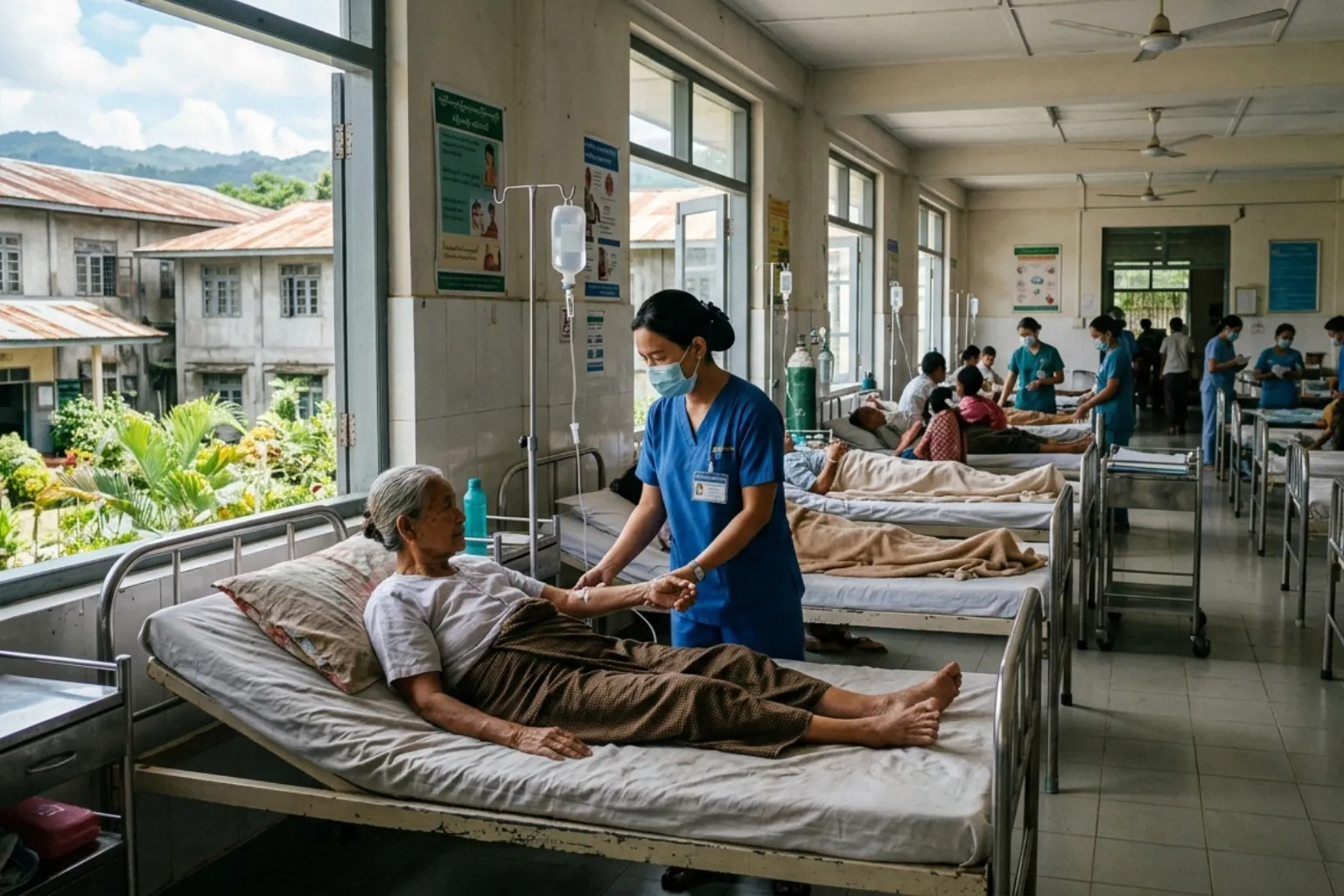
Myanmar's healthcare situation is difficult to describe without being blunt. The country's system has been under sustained pressure since the political changes of the early 2020s, and the effects are visible at every level of care. Understanding how hospitals are actually set up and functioning here requires looking at both the public and private sides of the system honestly.
The Public Hospital System: Structure and Reality
Myanmar's healthcare system includes public hospitals, private clinics, rural health centers, and traditional medicine practices. The Ministry of Health and Sports oversees the public healthcare system and sets national health policies.
Public hospitals are categorized into general hospitals with up to 2,000 beds, specialist hospitals and teaching hospitals with 100 to 1,200 beds, regional and state hospitals and district hospitals with 200 to 500 beds, and township hospitals with 25 to 100 beds. In rural areas, sub-township hospitals, station hospitals, rural health centers, and sub-rural health centers provide health services including public health services.
On paper, that sounds like a functioning tiered system. In practice, the gaps are significant. Public hospitals lack many of the basic facilities and equipment, and WHO consistently ranks Myanmar among the worst nations in healthcare. The problems go deeper than just equipment shortages. After the political upheaval, medicine and health care-related supplies increased three to four times in price. People now need to seek help and pick up daily medications for conditions such as hypertension, diabetes, and HIV in nearby towns. If nearby clinics are out of medicine, patients usually need to travel further distances, only to pay even higher prices.
The Private Hospital Sector: A Different World
There are more than 250 private hospitals across the country. Private hospitals operate primarily in larger cities and provide selected services to rural areas. The private tier functions almost as a separate system with its own supply chains and infrastructure. Facilities like Pun Hlaing or Asia Royal are designed to withstand local infrastructure failures. They have industrial backup generators, imported pharmaceutical stocks, and English-speaking doctors. The 2026 protocol for serious cases is to stabilize at these facilities and then evacuate to Thailand for anything more complex.
That evacuation pipeline to Thailand reflects a real structural truth about Myanmar's private healthcare setup: it functions as a bridge, not a destination for complex care. Wealthy populations often fly out of the country to seek higher-quality healthcare abroad. Thailand is the top destination, followed by India, Singapore, Malaysia, and Hong Kong.
Key Challenges in Setting Up Hospitals in Myanmar
Anyone planning a hospital setup in Myanmar in 2026 has to account for several practical realities that aren't always visible in sector reports.
- Power Supply: Electricity outages are frequent and unpredictable. Any serious medical facility must have independent generator capacity and fuel storage. Power cuts are frequent in 2026, making backup power a non-negotiable requirement before admitting to any smaller private clinic.
- Staffing: The Burmese healthcare industry is facing a significant shortage of facilities, technology, medical services, qualified nurses, and healthcare professionals. Many trained clinicians left the public system during the civil disobedience movement, and recruiting replacements is genuinely hard.
- Pharmaceutical Supply: Local supplies are mainly produced by the state-owned Myanmar Pharmaceutical Factory, and there are more than 100 pharmaceutical distributors currently operating. The market is very price-sensitive, and counterfeit products are prevalent, requiring stricter regulation and enforcement.
- Rural Access: People living in remote areas, who account for approximately 70 percent of Myanmar's total population, often lack adequate health knowledge, access to providers, and a reliable electricity supply, which is essential for the operation of medical equipment and storage of vaccines and medicines.
Sittwe General Hospital: A Case Study in Rethinking Hospital Design
One of the most instructive hospital projects currently underway in Myanmar is the Sittwe General Hospital masterplan in Rakhine State. Sittwe General Hospital is the only large general hospital in Rakhine State, serving over 3 million people. Article 25, appointed by UNOPS, is developing a masterplan for a modern 500-bed hospital, including new staff housing and essential infrastructure, to reshape healthcare delivery and eliminate annual flooding on the site.
A central Reception Hub is planned as a walk-in assessment center that patients pass through before being referred to outpatients or emergency care. Highly serviced functions such as operating theatres and laboratories are grouped together to simplify the hospital infrastructure. The design also allows wards to be used for treatment of infectious diseases like dengue and malaria that peak during the monsoon season.
This kind of context-aware design is exactly what works in Myanmar. A hospital that ignores local realities - flooding, disease seasonality, unstable power - will fail regardless of the quality of its equipment. If you want to go deeper on how designing hospitals for maximum efficiency works in practice, the principles are surprisingly transferable across resource-constrained settings.
What the Health Cluster Strategy Says for 2025–2026
In an environment with ever-increasing needs and decreased funding, the priorities for 2025 and 2026 include advocating for increased access to quality health services through mobile clinics, static health facilities, and teleconsultation with a strong focus on sexual and reproductive health services, inclusion of people with disabilities, and strengthening quality of access to data for needs analysis and informed decision-making.
This tells us something important about the direction of hospital setup planning in Myanmar right now. The focus is not primarily on building large flagship hospitals. It is on expanding reach through smaller, mobile, and connected facilities that can serve displaced and rural populations where they are. The full scope of these priorities is outlined in the Myanmar Health Cluster Strategy 2025–2026, published on ReliefWeb.
Hospital Setup in Bhutan: Small Country, Thoughtful System
Bhutan takes a fundamentally different approach to healthcare, and it's worth understanding why. The country operates within tight resource constraints - it's landlocked, mountainous, and has a small population - but it has made deliberate choices about how to structure its hospital system that other countries in the region can genuinely learn from.
Universal Healthcare: The Foundation
Since the 1970s, the Bhutan government has offered free universal healthcare to all its citizens. Barring one private health clinic in the capital of Thimphu, there are no private physicians or clinics. There are more than 30 hospitals across Bhutan, and except for Gasa, every district has at least one government hospital. For those looking at hospital project consulting in Bhutan, understanding this government-first structure is the essential starting point for any planning work.
The system is organized into three tiers. Bhutan's three-tiered health system is designed for proper care coordination and referral of patients with free ambulance services. At the top sits the national referral hospital in Thimphu. Below that are regional referral hospitals, and at the base are district hospitals, basic health units, and outreach clinics.
Key Hospitals and Their Roles
| Hospital | Location | Capacity / Role |
|---|---|---|
| Jigme Dorji Wangchuck National Referral Hospital (JDWNRH) | Thimphu | Largest hospital in Bhutan; primary, secondary, and tertiary services; national referral center |
| Mongar Regional Referral Hospital | Mongar | 150-bed hospital covering medical, surgical, pediatric, orthopedic, and psychiatric specialties |
| Paro General Hospital | Paro | 40-bed facility serving regional healthcare needs |
| District Hospitals | Across all Dzongkhags | Serve as referral centers for basic health units and outreach clinics |
As of today there are 28 hospitals, 156 BHUs, and 654 outreach clinics in Bhutan. That network of outreach clinics is especially significant for a country where geography makes centralized care genuinely impractical for large parts of the population.
The Referral System and Cross-Border Care
One of the most honest features of Bhutan's hospital setup is that it formally acknowledges what it cannot do. For complex medical procedures that cannot be conducted within Bhutan, patients are referred to India. A referral committee at JDWNRH determines the eligibility of cases for referral, and the government covers all associated costs, including travel. Common referrals include cardiac and neurosurgeries, kidney transplants, and cancer treatments.
That's a mature policy position. Rather than pretending its hospitals can do everything, Bhutan has built a formal pathway to specialized care abroad, paid for by the state. It protects patients and keeps the domestic system focused on what it can genuinely deliver.
Digital Health and Infrastructure Upgrades in Bhutan
Bhutan has been making quiet but meaningful progress on the digital side of its healthcare setup. The Enhanced Bhutan Electronic Medical Supply Inventory System (eBMSIS) has been launched to strengthen medical supply and inventory management, ensuring that life-saving medicines and critical supplies reach patients when and where they are needed. Both this platform and the mWASTE system are integrated into the electronic Patient Information System (ePIS). You can read more about these digital health milestones in the UNDP Bhutan digital health report.
With an investment of USD 2.2 million, a project to improve infectious waste management has helped Bhutan handle the surge in infectious waste during the COVID-19 pandemic. 112 health facilities across 15 districts have been equipped with autoclave machines for proper treatment of infectious waste before incineration or disposal.
The Ministry of Health has also been actively procuring Mobile Medical Units for hospitals, which makes sense in a country where many communities are simply too remote for a fixed facility to serve them well. These units bring basic diagnostic and treatment capacity to populations that would otherwise have to travel several hours on difficult mountain roads.
Challenges Bhutan Still Faces
Even within a well-intentioned universal system, gaps exist. There are often gaps of many months to years when a replacement doctor is posted in hospitals, during which people have to travel to higher health centers due to discontinuity of services. Among those who cannot afford self-referral to higher centers, there is a definite delay in diagnosis and treatment of disease conditions leading to an overall increase in the cost of treatment.
There is also a dependence on foreign-trained doctors that creates its own fragility. Bhutan lacks a medical college and all its undergraduate medical students and dental surgeons are trained outside the country. That is a structural vulnerability the country is working to address through the Khesar Gyalpo University of Medical Sciences of Bhutan, but building domestic medical training capacity takes time.
Let’s Build Your Dream Hospital
Whether you’re planning a new hospital, expanding an existing facility, or upgrading your healthcare technology, Actiss Healthcare is here to guide you every step of the way. Let us help you turn your vision into reality. Contact us today for a free consultation & learn more about our services and how we can support your next healthcare project.

Comparing Myanmar and Bhutan: Hospital Setup Side by Side
| Factor | Myanmar | Bhutan |
|---|---|---|
| Healthcare Model | Mixed public-private; heavily strained public system | Universal public healthcare; minimal private sector |
| Number of Hospitals | 1,000+ public hospitals; 250+ private hospitals | 28 hospitals; 156 BHUs; 654 outreach clinics |
| Major Challenge | Political instability, staff shortages, power supply | Geographic remoteness, specialist shortages, dependence on foreign training |
| Cross-border referral | To Thailand (private patients) | To India (government-funded) |
| Digital Health Progress | Limited; mobile clinics and teleconsultation being scaled | Active ePIS, eBMSIS, mobile medical units |
| Healthcare Spending | 4.79% of GDP; largely out-of-pocket | Government-funded; free at point of care for citizens |
Regional Considerations: What's Shaping Hospital Setup Across Southeast Asia in 2026
The Digital Health Push
Across the region, digital health is no longer a pilot project - it's becoming part of how hospitals actually function. The Asia-Pacific telemedicine market is expected to double from US $40.64 billion in 2025 to US $80.37 billion by 2030. The fastest-growing technologies include telehealth and virtual care, AI-powered diagnostics, and mHealth wearables.
Looking toward 2026, telemedicine will function within structured hybrid care models across Asia. Health systems are expected to route care based on clinical need, using digital entry points for low-acuity concerns, remote monitoring for chronic conditions, and in-person visits for diagnostic and procedural services.
For countries like Myanmar and Bhutan, where geography or instability limits physical hospital coverage, this hybrid model is not just convenient - it may be the only way to reach large parts of the population.
The Urban-Rural Divide Remains the Core Problem
No matter how impressive a country's flagship hospitals are, the urban-rural divide remains the defining problem of healthcare access in Southeast Asia. A growing number of funds are looking to the fields of telehealth and telemedicine, leveraging Southeast Asia's strong digital connectivity to address the gap in healthcare services, noting that almost 40% of people in the region are already paying out of their own pocket for care.
Hospital setup strategies that ignore the rural majority are, frankly, strategies that serve a minority of the population. The most effective approaches in 2026 combine a strong referral network, mobile or satellite facilities, and teleconsultation - not just new buildings in capital cities.
AI and Smart Hospital Infrastructure
The Asia-Pacific AI in healthcare market will grow at a 42.5% CAGR, and the region's healthcare AI market is predicted to reach US $100.07 billion by 2033. In practical hospital setup terms, this means AI-assisted diagnostics, automated triage, and predictive supply chain management are all becoming realistic tools - not just for Singapore or Bangkok, but for mid-tier facilities across the region that are willing to invest in the right infrastructure. A closer look at smart hospitals and IoT-driven automation in healthcare design shows just how accessible some of these systems are becoming for new builds in developing markets.
Pharmaceutical Supply Chain Security
One lesson that both Myanmar and Bhutan illustrate - in very different ways - is that a hospital is only as good as its supply chain. Myanmar faces counterfeit drug problems and import restrictions. Bhutan has built its own digital inventory management system specifically to address supply gaps. Both situations point to the same conclusion: when setting up a hospital in this region, pharmaceutical logistics is not a secondary concern. It has to be central to the planning process from day one.
International Accreditation and Medical Tourism
Southeast Asia remains one of the fastest-growing regions for medical travel. International accreditation ensures adherence to globally recognized safety and quality standards, which reassures patients and insurers when selecting providers. Integrated patient services such as travel coordination, language support, and concierge care significantly improve the overall experience and reduce logistical barriers.
Thailand currently receives over a million medical tourists a year. Vietnam is growing rapidly. Countries like Myanmar, which have privately invested in internationally equipped facilities, are not fully positioned to compete in medical tourism yet - but the infrastructure groundwork is there.
Practical Considerations for Hospital Setup in This Region
Infrastructure Must-Haves
Getting the physical setup right requires thinking well beyond the floor plan. Every system that runs through a hospital - power, water, drainage, medical gases, data - has to be planned for the specific conditions of the country. A detailed guide on hospital MEP systems planning is a useful reference for anyone working through these decisions for the first time.
- Independent power supply: Generators, solar backup, and fuel storage are non-negotiable in countries with unreliable grid power.
- Water and waste management: Especially in areas prone to flooding, the hospital site selection process and drainage design can determine whether a facility is functional during monsoon season.
- Connectivity: Even basic facilities now need internet access for teleconsultation, inventory systems, and electronic records.
- Staff housing: In remote postings, the absence of decent accommodation is one of the main reasons healthcare workers refuse positions. Facilities that include staff housing retain staff more successfully.
Regulatory and Governance Framework
- In Myanmar, the Ministry of Health oversees licensing through six departments. Private hospital setup requires compliance with the Law Relating to Private Health Care Services and MOH registration.
- In Bhutan, the Healthcare Services Rules and Regulations 2025 govern private clinical diagnostic centers and facility operations. The Bhutan Medicines Board governs pharmaceutical supply and quality.
- Across the region, regulatory frameworks for digital health - particularly teleconsultation and cross-border data sharing - are still developing. Checking current policy before building telehealth into a hospital's operating model is essential.
Conclusion
Setting up a hospital in Southeast Asia in 2026 is not a one-size-fits-all exercise. Myanmar and Bhutan represent two very different versions of the challenge. Myanmar shows what happens when a system fragments under pressure - the private sector steps in, but reaches only those who can afford it, while the public system struggles to serve the majority. Bhutan shows that a small, resource-limited country can build something coherent and humane if it focuses on what it can actually deliver, is honest about its limitations, and plans its referral pathways carefully. Across the broader region, the direction is clear: digital health, hybrid care models, and context-aware infrastructure design are the defining trends of 2026. The best hospital setups are not the most expensive ones. They're the ones that actually function in the reality of the country where they're built. If you're starting this process, a solid grounding in hospital planning and designing is where the work genuinely begins.
Frequently Asked Questions (FAQs)
1. What are the biggest challenges for hospital setup in Myanmar in 2026?
The main challenges are reliable power supply, shortage of trained healthcare professionals, access to genuine pharmaceutical supplies, and connectivity in rural areas. Political instability has also disrupted supply chains and reduced the healthcare workforce significantly since the early 2020s. Any serious hospital setup in Myanmar must plan for backup power, on-site pharmacy storage, and staff retention strategies from the outset.
2. Does Bhutan allow private hospitals to operate?
Private healthcare in Bhutan is extremely limited. As of 2026, there is essentially one private health clinic in Thimphu. The system is predominantly a government-run universal healthcare model. The Ministry of Health has been issuing updated rules under the Healthcare Services Rules and Regulations 2025 for private clinical diagnostic centers, signaling some incremental opening of space for private diagnostics - but the country remains committed to its public healthcare model.
3. Which Southeast Asian country has the best hospital infrastructure in 2026?
Singapore consistently leads the region in hospital quality, technology, and outcomes. Thailand is the regional leader in medical tourism, with internationally accredited hospitals in Bangkok and major cities offering procedures at a fraction of Western costs. Malaysia also maintains strong infrastructure. Myanmar, Cambodia, and Laos face the most significant access and quality challenges, though major private hospitals in Yangon are internationally equipped.
4. How is digital health changing hospital setup planning in Southeast Asia?
Digital health is reshaping planning in fundamental ways. Telemedicine integration, electronic patient record systems, AI-assisted diagnostics, and digital pharmaceutical inventory management are now core components of functional hospital design in the region. For remote or underserved areas in countries like Myanmar and Bhutan, teleconsultation is often the primary way specialists reach patients - meaning connectivity infrastructure is as important as physical building design.
5. What is the referral system for complex medical cases in Bhutan?
Bhutan operates a formal government-funded international referral system for cases that cannot be treated domestically. A referral committee at Jigme Dorji Wangchuck National Referral Hospital reviews cases and approves transfers to hospitals in India. The government covers all costs, including travel, for approved referrals. Common cases referred abroad include cardiac surgery, neurosurgery, kidney transplants, and cancer treatment, as these specialties are not yet fully available within Bhutan.