Hospital Project Consulting in Bangladesh - Requirements and Process Explaineds
Starting a hospital in Bangladesh is one of the most rewarding investments you can make - and one of the most complex. Between navigating a multi-agency approval system, meeting building codes, and securing over a dozen separate licences, the process can feel like a full-time job before a single brick is even laid. That is exactly where a professional hospital project consultant comes in. If you are a healthcare investor, a doctor planning your own facility, or an institution looking to expand, this guide will walk you through everything you need to know about hospital project consulting in Bangladesh in 2026 - the requirements, the step-by-step process, and the pitfalls to avoid.
Why Hospital Project Consulting Matters in Bangladesh
Bangladesh's private healthcare sector is growing fast. The private sector delivers roughly 64 to 80 percent of all healthcare in the country, accounting for approximately $1.49 billion of total health expenditure. According to data from the Bangladesh Investment Development Authority (BIDA), the medical device sector alone was projected to nearly double from $442 million in 2020 to $820 million by 2025, driven by an aging population and rising non-communicable diseases.
Yet despite this growth, the regulatory side of building a hospital remains very challenging. As of late 2025, Bangladesh had around 15,000 private hospitals and clinics, but only 6,024 were officially registered with the Directorate General of Health Services (DGHS). The reasons are clear - the licensing process is fragmented across multiple government bodies, and approvals can sometimes take two to three years even when all documents are submitted correctly.
Many investors only discover how deep this complexity runs after they have already committed capital. Understanding when to bring in a hospital project consultant - and why doing it early matters - can save you months of delays and significant cost overruns. A qualified consultant handles feasibility, planning, design, regulatory filings, and project management, giving you a realistic shot at opening your facility on time and within budget.
Types of Healthcare Facilities That Need Consulting in Bangladesh
Hospital project consulting is not limited to large multi-specialty hospitals. In Bangladesh, the following types of healthcare facilities typically benefit from professional consulting support:
- Single-specialty hospitals (cardiac, orthopaedic, eye, maternity)
- Multi-specialty hospitals with multiple departments and high bed counts
- Diagnostic centres and imaging labs
- Nursing homes and clinics in district or upazila towns
- Medical college hospitals with teaching facilities
- Blood banks and rehabilitation centres
- Telemedicine and outpatient care centres in rural areas
Whether you are building a 10-bed clinic in Sylhet or a 500-bed multi-specialty hospital in Dhaka, the regulatory framework you must comply with remains largely the same - only the scale of documentation and construction standards differs.
Key Regulatory Bodies Involved in Hospital Projects in Bangladesh
One of the first things a good consultant will tell you is that hospital approval is not handled by a single authority. You need to work with several government bodies at the same time. Here is a breakdown of the main agencies and their roles:
1. Directorate General of Health Services (DGHS)
The DGHS, operating under the Ministry of Health and Family Welfare, is the primary licensing body for all private hospitals, clinics, blood banks, nursing homes, and diagnostic centres in Bangladesh. The DGHS runs the registration and renewal process through an online portal. Without a DGHS hospital licence, you cannot legally operate any healthcare facility in the country. For hospitals with more than 50 beds, a management board led by a senior physician is also required.
2. Bangladesh Investment Development Authority (BIDA)
If you are a healthcare investor - especially a foreign investor - you must first submit a project proposal to BIDA for review and approval before proceeding. Only after BIDA registration can companies investing in hospitals and medical education apply to the DGHS for a facility licence.
3. RAJUK / City Corporation
RAJUK (Rajdhani Unnayan Kartripakkha) or the relevant City Corporation handles building plan approvals and architectural clearances. A layout plan authorised by RAJUK or the City Corporation is a mandatory document for both fire safety and environmental clearance applications.
4. Fire Service and Civil Defence (FSCD)
The FSCD, under the Ministry of Home Affairs, issues fire safety licences for all hospital buildings. You need to submit a completed application along with supporting documents including a No-Objection Certificate (NOC), TIN, VAT, trade licence, RAJUK-approved layout plan, and a clearance certificate from the FSCD office itself. Fire safety compliance is not just a regulatory box to tick - it is a critical design and planning consideration. For a deeper look at what is involved, this hospital fire safety compliance guide covers the subject in detail.
5. Department of Environment (DoE)
An environmental clearance certificate is mandatory for hospital projects. A known problem in the system today is that DGHS sometimes requires the environmental certificate before the hospital licence, while the DoE may need the hospital licence first - a circular dependency that consultants can help you resolve through proper sequencing of applications.
6. City Corporation / Municipal Authority
A trade licence issued by the City Corporation or municipal authority in your area is one of the earliest documents you will need. For clinics and private hospitals, this requires prior permission from the Director General of Health Services.
Full List of Licences and Documents Required
Running a private hospital in Bangladesh currently requires up to 18 different licences within a year. This is not an exaggeration - it is what hospital operators themselves report. Here is a consolidated list of the key documents and approvals needed:
| # | Document / Licence | Issuing Authority |
|---|---|---|
| 1 | Company Registration (Memorandum of Association) | RJSC (Registrar of Joint Stock Companies) |
| 2 | BIDA Registration / Project Proposal Approval | Bangladesh Investment Development Authority |
| 3 | Trade Licence | City Corporation / Municipality |
| 4 | Hospital / Clinic Licence | DGHS (via online portal) |
| 5 | Building Plan / Layout Approval | RAJUK / City Corporation |
| 6 | Fire Safety Licence | Fire Service and Civil Defence (FSCD) |
| 7 | Environmental Clearance Certificate | Department of Environment (DoE) |
| 8 | Medical Waste Management Permit | Department of Environment |
| 9 | VAT Registration Certificate | National Board of Revenue (NBR) |
| 10 | Tax Identification Number (TIN) | National Board of Revenue (NBR) |
| 11 | Radiation Safety Licence (if applicable) | Bangladesh Atomic Energy Commission |
| 12 | Narcotics and Drug Licence (if applicable) | Department of Narcotics Control |
The exact list varies based on your bed count, the services you plan to offer, and your location (Dhaka vs. a district town). A consultant ensures you are chasing only the approvals that apply to your specific project - nothing extra, nothing missing.
Let’s Build Your Dream Hospital
Whether you’re planning a new hospital, expanding an existing facility, or upgrading your healthcare technology, Actiss Healthcare is here to guide you every step of the way. Let us help you turn your vision into reality. Contact us today for a free consultation & learn more about our services and how we can support your next healthcare project.

The Hospital Project Consulting Process: Step by Step
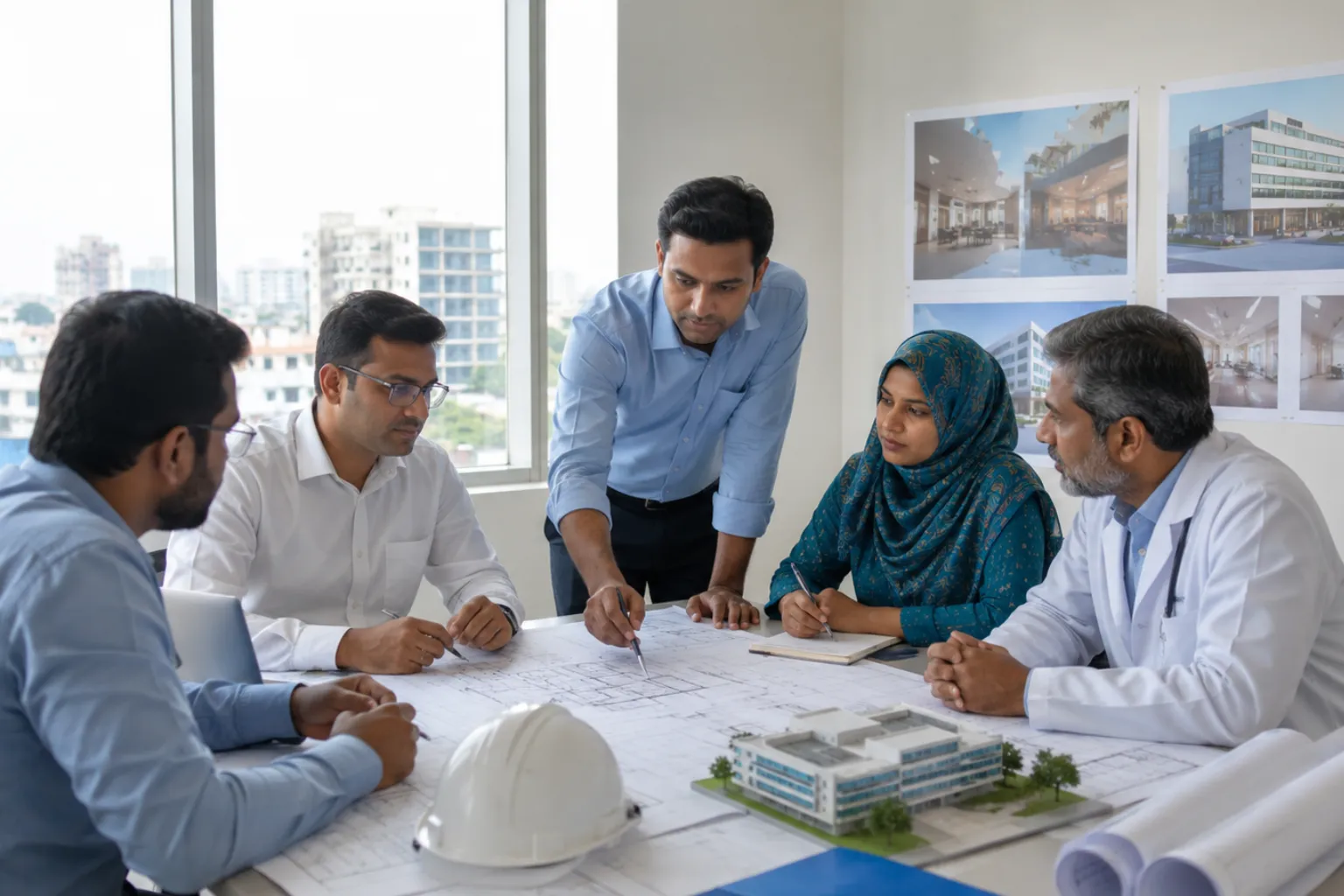
A professional hospital project consultant in Bangladesh typically works through five major phases. Here is how the process unfolds from your first conversation to the day you open your doors.
Phase 1: Feasibility Study and Market Analysis
This is the foundation of the entire project. Before you spend a single taka on land or construction, a good consultant will conduct a detailed hospital feasibility study covering two main areas:
Market Demand Analysis
The consultant examines the catchment population - size, demographics, age distribution, disease burden, and growth trends. They look at existing competitors, their bed capacity, and the services they offer. Consultants often warn that many investors overestimate urban demand and underestimate how price-sensitive patients are. Getting this analysis right determines the type of hospital, the required specialties, and a realistic bed count.
Financial Feasibility
A financial model is built that covers the full investment picture - land, construction, medical equipment, working capital, and recurring operating costs. Key metrics like the Internal Rate of Return (IRR), Net Present Value (NPV), and Debt Service Coverage Ratio (DSCR) are calculated. Investors typically look for an IRR above 15 percent. The consultant also advises on the right debt-to-equity ratio and how to approach banks or other funders. A full feasibility study generally takes between 2 and 4 months depending on the project's size and data availability.
Phase 2: Pre-Planning and Site Assessment
Once the feasibility study signals a green light, the project moves into pre-planning. This phase is all about the physical and legal groundwork:
- Site Analysis: Soil testing, topography review, utility availability (water, power, drainage), and road connectivity are all assessed. Proximity to residential areas and ease of access for patients and ambulances are critical factors.
- Master Planning: A preliminary layout is created covering department flow, bed distribution, OPD, IPD, ICU, OT, and diagnostic zones. Getting patient flow right at this stage prevents expensive redesigns later.
- Medical Technology Planning: The consultant maps out major equipment needs - MRI machines, CT scanners, cath labs - and their architectural implications (weight loads, shielding, dedicated electrical circuits).
- Regulatory Compliance Mapping: The consultant identifies every licence required for your specific facility type and sequences the applications in the right order to avoid circular-dependency traps.
This phase also includes early conversations with banks and investors to discuss construction financing and long-term funding options.
Phase 3: Architectural Design, Approval, and Construction
With pre-planning complete, the project moves into the design and build stage. Poor decisions made during this phase are often irreversible and expensive - in fact, many first-time hospital investors fall into avoidable traps that are well documented in this breakdown of common hospital design mistakes. During this phase specifically:
- Architectural drawings are finalised and submitted to RAJUK or the relevant City Corporation for building plan approval.
- MEP (Mechanical, Electrical, and Plumbing) design is completed, including medical gas systems, HVAC, infection control air handling units, and fire suppression systems.
- Building codes under the Bangladesh National Building Code (BNBC) must be followed throughout the design and construction process.
- The FSCD fire safety plan is prepared and submitted alongside the RAJUK-approved layout.
- Contractors are selected through a bidding process, and project management oversight begins.
Hospital planning and design typically takes between 3 and 6 months for most projects. Construction timelines vary widely depending on scale - a 50-bed hospital might take 18 months to build, while a 300-bed facility could take 3 to 4 years.
Phase 4: Licensing, HR Planning, and Operations Setup
Long before your building is finished, your consultant will be working on the operational side of the hospital. This is a phase many first-time hospital investors underestimate, and it is where projects often stumble. Key tasks here include:
- Submitting the DGHS hospital licence application through the online portal with the full document package.
- Obtaining environmental clearance from the DoE, including a medical waste management plan.
- Finalising fire service and FSCD clearance.
- Beginning recruitment of medical staff, nursing staff, administrative personnel, and support staff.
- Setting up the Hospital Information System (HIS) and Electronic Medical Records (EMR) software. Choosing the right platforms at this stage matters - a detailed guide on PACS, EMR, and HIS systems helps you make an informed decision.
- Drafting internal policies, quality protocols, and infection control procedures.
Hospitals that fail to launch smoothly often do so not because of design or finance issues, but because HR and systems are not ready when the building is. A phased implementation plan with clear milestones is essential here.
Phase 5: Commissioning, Accreditation, and Launch
The final phase covers the period between construction completion and your first patient. Consultants work through a structured hospital commissioning checklist to verify that all systems - HVAC, medical gases, fire alarms, IT infrastructure, sterilisation units - are fully tested and operational. Staff training and simulation drills are conducted. A soft launch with limited services allows teams to identify operational gaps before full operations begin.
Accreditation is also pursued in this phase. Accredited hospitals in Bangladesh enjoy higher patient trust, legal protection, access to government and donor funding, and stronger staff recruitment outcomes. A quality grading system from A to D has been proposed by the DGHS reform commission, which will soon make quality-based accreditation a standard part of hospital operations.
Challenges in the Current System (And What Is Changing)
It would not be fair to give you a guide on hospital project consulting without being honest about the pain points in Bangladesh's current regulatory environment. Here is what the data says:
The Licensing Bottleneck
The DGHS and other agencies currently operate as separate licensing windows. Getting your environmental clearance, fire safety licence, and DGHS hospital licence requires dealing with three different offices, each with its own document list, timelines, and sometimes conflicting requirements. Approvals have taken two to three years in many documented cases even when documents were in order. Hospital operators have called for all licensing to be handled through a single authority or a third-party system like BGMEA.
Reform on the Way in 2025-2026
The good news is that change is coming. The DGHS has officially taken an initiative to simplify the licensing and renewal process for private hospitals, clinics, and diagnostic centres. Officials are considering extending licence validity from one year to two or three years, and a single-window system for multi-agency approvals is being discussed. A reform commission has also recommended launching a dedicated "single service centre" for all licensing functions of private health facilities. These changes, if fully implemented, will significantly reduce the time and cost of hospital project approvals in Bangladesh.
Comparing Hospital Consulting Service Types in Bangladesh
| Consulting Type | Scope of Work | Best For |
|---|---|---|
| Full-service / Turnkey Consulting | Feasibility to commissioning, all phases covered | Investors with no prior hospital experience |
| Regulatory / Licensing Consulting | DGHS, BIDA, FSCD, DoE filings and follow-ups | Facilities already built that need approvals |
| Architectural and MEP Consulting | Building design, RAJUK approval, BNBC compliance | Investors with their own project management team |
| Feasibility-Only Consulting | Market study, financial model, project report | Pre-investment decision-making |
| Operations Consulting | HR, HIS setup, policies, staff training | Hospitals nearing commissioning |
How Much Does Hospital Project Consulting Cost in Bangladesh?
Consulting fees vary depending on the scope and scale of your project. A feasibility study alone typically costs between 0.5 and 1 percent of the total projected project cost. For a BDT 30 crore hospital project, that translates to roughly BDT 15 to 30 lakh for the feasibility study alone. Full-service turnkey consulting - from feasibility through commissioning - is typically structured as a percentage of total project cost or as a fixed fee broken across milestone payments. Given that poor planning decisions can cost multiples of what a consultant charges, the investment almost always pays for itself.
Tips for Choosing the Right Hospital Project Consultant in Bangladesh
If you are specifically planning a facility in Bangladesh, working with a firm that has direct, on-the-ground experience with local regulatory bodies, DGHS filing norms, and BNBC compliance will save you far more than their fees. You can learn more about what a specialist hospital project consulting firm in Bangladesh actually handles from project inception to launch.
- Check specialisation: Look for firms that work exclusively or primarily in healthcare projects, not general business consultants who occasionally handle hospitals.
- Ask for a proven track record: Request references or case studies from past hospital projects in Bangladesh - ideally in a similar city or bed-count range to yours.
- Verify regulatory knowledge: Your consultant must know DGHS, BIDA, RAJUK, FSCD, and DoE requirements thoroughly. A gap here will cost you months.
- Look for multidisciplinary teams: The best consulting firms bring together architects, engineers, healthcare management experts, and legal and documentation specialists under one roof.
- Clarify the fee structure: Make sure deliverables and payment milestones are clearly defined in a written agreement before work begins.
Conclusion
Hospital project consulting in Bangladesh is not a luxury - it is a practical necessity given the regulatory complexity of building a healthcare facility in this country. From DGHS licensing to BIDA registration, from RAJUK building approvals to FSCD fire safety clearance, the list of requirements is long and the process is non-linear. A professional hospital project consultant brings structure, regulatory knowledge, and project management discipline to what would otherwise be a very stressful and expensive process. With the Bangladeshi healthcare sector growing steadily and reforms to the licensing system actively underway in 2025 and 2026, there has never been a better time to plan your hospital project properly. Get the consulting right from the start, and the rest of the project has a much stronger foundation to stand on.
Let’s Build Your Dream Hospital
Whether you’re planning a new hospital, expanding an existing facility, or upgrading your healthcare technology, Actiss Healthcare is here to guide you every step of the way. Let us help you turn your vision into reality. Contact us today for a free consultation & learn more about our services and how we can support your next healthcare project.
Frequently Asked Questions (FAQs)
1. Do I need a hospital project consultant if I am building a small clinic in Bangladesh?
Yes - even small clinics and nursing homes in Bangladesh need multiple licences, including a DGHS registration, trade licence, and fire safety clearance. A consultant helps you identify which approvals apply to your specific facility and handles the documentation so you do not lose time chasing the wrong offices in the wrong order.
2. How long does it take to get DGHS approval for a new private hospital in Bangladesh?
In practice, DGHS approvals have taken two to three years in many cases due to overlapping requirements between multiple agencies. However, with a consultant managing your application and pre-empting common document issues, the timeline can be significantly shortened. The government's proposed single-window system is also expected to reduce this timeline once fully operational.
3. Can foreign investors build and run hospitals in Bangladesh?
Yes. Bangladesh's healthcare sector is open to foreign private investment. Foreign investors must first register with the Bangladesh Investment Development Authority (BIDA) and submit a project proposal for review. After BIDA approval, they proceed to DGHS for the hospital licence. The country's foreign investment policy is based on the Foreign Private Investment (Promotion and Protection) Act.
4. What is the typical cost of a hospital feasibility study in Bangladesh?
A hospital feasibility study generally costs between 0.5 and 1 percent of the total projected project cost. The study typically takes 2 to 4 months to complete and covers market demand analysis, financial modelling, site assessment, regulatory compliance mapping, and service mix planning.
5. What is the difference between DGHS registration and hospital accreditation in Bangladesh?
DGHS registration is a legal requirement - without it, you cannot operate a private hospital. Accreditation, on the other hand, is a quality-based assessment that certifies your facility meets specific standards of care. While accreditation is currently voluntary, the DGHS reform commission has proposed a quality grading system (A to D) that may soon make accreditation a standard part of hospital operations in Bangladesh.