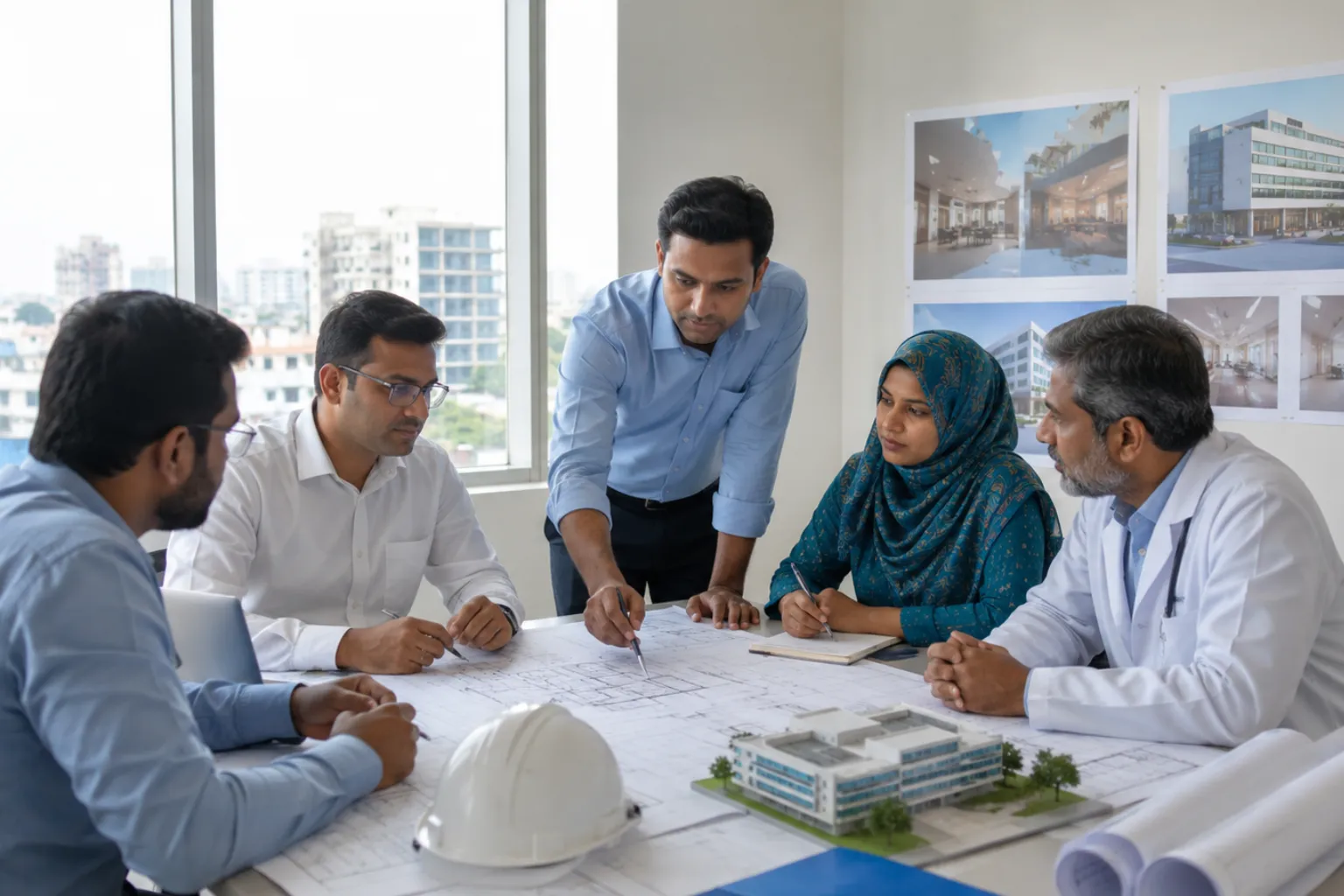

Hospital Detailed Project Report (DPR): What It Must Include
Building a hospital is one of the most complex infrastructure projects anyone can take on. Unlike a commercial building or a residential complex, a hospital serves a direct life-saving function, which means every single decision, from how many beds go on which floor to what type of backup power system to install, carries real weight. That is exactly why a Hospital Detailed Project Report (DPR) exists. It is the backbone document that guides every stakeholder, whether that's a government body, a private investor, a bank, or the hospital management team, from concept to operation.
If you are planning to set up a new hospital, expand an existing one, or apply for funding from a financial institution or government scheme, you absolutely need a solid DPR in hand. This article breaks down what a hospital DPR must include, why each section matters, and how to get it right.
What Is a Hospital Detailed Project Report (DPR)?
A Detailed Project Report (DPR) is a comprehensive document that outlines every aspect of a proposed hospital project. Think of it as a complete blueprint, not just of the physical structure, but of the business, financial, clinical, and operational side of running a healthcare facility.
Banks and financial institutions require a DPR before they approve any loan for hospital construction or expansion. Government bodies like the National Health Mission (NHM) in India or state health departments ask for it before granting approvals or subsidies. Even private equity investors and healthcare chains want to see a detailed DPR before committing capital. In short, no serious hospital project moves forward without one.
A well-prepared hospital DPR is not just a formality. It is a planning tool. It forces the promoter to think through every major decision before the first brick is laid, which reduces costly mistakes later.
Why a Hospital DPR Is More Than Just a Document
Many promoters treat the DPR as a paperwork exercise. That is a mistake. When done correctly, a hospital DPR helps you validate your idea before you spend money. It tells you whether your proposed location has enough patient demand, whether your bed capacity matches the population it serves, whether your financial projections are realistic, and whether your planned services are clinically relevant to the area.
It also acts as a communication tool. When you hand a well-structured DPR to a bank manager, an investor, or a government official, it shows that you have done the homework. That builds trust, which matters a great deal when you are asking someone to back a multi-crore project.
Key Components Every Hospital DPR Must Include
Below are the core sections that a hospital Detailed Project Report must cover. Each one plays a specific role in making the overall document credible, complete, and useful.
1. Executive Summary
The executive summary sits at the beginning but is usually written last. It gives a quick overview of the entire project in two to three pages. It covers the name of the promoter, the proposed location, the type of hospital (multispecialty, single specialty, or general), the total number of beds, the total project cost, the funding mix (debt vs. equity), and the expected break-even timeline.
The goal here is simple: someone reading just this section should get a clear picture of what the project is about and why it is viable. Keep it factual and specific. Avoid vague language.
2. Promoter and Organization Background
This section introduces the people behind the project. Who are the promoters? What is their professional background? Do they have prior experience in healthcare, or is this their first hospital project? If there is a management team already in place, their credentials go here too.
For a bank or an investor, this section answers a critical question: can these people actually run a hospital? If the promoter has strong credentials, like a medical professional with 20 years of practice or a healthcare group that already runs successful hospitals in other cities, this section strengthens the entire DPR significantly.
3. Project Background and Objectives
Here you explain why this hospital is being built. What gap does it fill? Is the area underserved? Are patients currently traveling 50 kilometers to access secondary care? Are there no ICU beds within a particular district? This section should present clear, data-backed reasons for why this hospital needs to exist.
State the objectives clearly. For example: to provide 100-bed multispecialty care to a population of 5 lakh people in XYZ district, to reduce out-of-pocket healthcare expenses for the local community, or to establish a center of excellence for cardiac care in the region.
4. Market and Demand Analysis
This is one of the most critical sections of the DPR and often the one that gets the least attention. A thorough hospital feasibility study forms the foundation of this section and helps you understand whether the demand actually justifies the investment. The market analysis should cover:
- The catchment area population (primary, secondary, and tertiary zones)
- Current healthcare infrastructure in the area (number of hospitals, beds per 1,000 people)
- Disease burden and common medical conditions in the region
- Patient outflow to other cities or districts for specialized care
- Income levels and willingness to pay in the catchment area
- Competition analysis: other hospitals in the area and their service gaps
Use data from government health reports, the National Family Health Survey (NFHS), district health bulletins, and local census data wherever possible. Real numbers make this section much more credible.
5. Site Analysis and Location Study
The location of a hospital affects almost every other aspect of the project. This section should cover the exact address of the proposed site, its proximity to residential areas, road connectivity, distance from public transport, and availability of utilities like water, electricity, and sewage disposal.
You should also include the land area in square feet or acres, whether the land is owned or leased, and the current status of land title. If there are any legal disputes around the land, disclose them here and explain how they are being resolved. Getting site selection right from day one is something many promoters underestimate, and a detailed guide on hospital site selection can help you avoid expensive location mistakes before any commitment is made.
6. Hospital Design and Architectural Plan
This section covers the physical design of the hospital. It should include the total built-up area, the number of floors, and how each floor is used. A clear layout plan shows which floor houses the emergency department, OPD, wards, ICUs, operation theaters, radiology, pharmacy, administration, and support services.
The design must comply with the guidelines issued by the Bureau of Indian Standards (BIS) for hospital buildings, National Building Code norms, and state-specific regulations. If you are aiming for NABH accreditation, refer to the step-by-step NABH accreditation process for new hospitals to make sure your space and safety requirements are built into the design from the very start, rather than retrofitted later at significant cost.
7. Bed Strength and Department-wise Breakdown
One of the most practical sections, this part tells the reader exactly how many beds the hospital will have and how they will be distributed. A sample breakup for a 100-bed hospital might look like this:
| Department / Ward | Number of Beds | Category |
|---|---|---|
| General Ward | 30 | General |
| Semi-Private Ward | 20 | Semi-Private |
| Private Rooms | 15 | Private |
| ICU (General) | 10 | Critical Care |
| NICU / PICU | 5 | Critical Care |
| Maternity Ward | 10 | Obstetrics |
| Pediatric Ward | 5 | Pediatrics |
| Emergency / Casualty | 5 | Emergency |
| Total | 100 |
This breakdown helps the reader understand the hospital's clinical capacity and its target patient mix. It also feeds directly into the revenue projections section.
8. Proposed Clinical Services and Specialties
List all the clinical departments and specialties the hospital plans to offer. For a multispecialty hospital, this might include internal medicine, general surgery, orthopedics, gynecology and obstetrics, pediatrics, cardiology, nephrology, gastroenterology, neurology, oncology, and ENT, among others.
For each specialty, mention whether the hospital will have a full-time specialist or a visiting consultant, especially in the early phases. This helps banks and investors understand how quickly the hospital can start generating revenue.
9. Medical Equipment and Technology Plan
A hospital without proper equipment is just a building. The equipment plan should list all the major medical equipment the hospital needs, along with their estimated costs. This includes imaging equipment (X-ray, ultrasound, CT scan, MRI), laboratory equipment, operation theater equipment, ICU monitors, ventilators, laparoscopy systems, and more. First-time hospital owners often find this section overwhelming, and a structured equipment planning guide can walk you through prioritization and procurement sequencing without overshooting your budget.
For each major item, specify whether you plan to purchase it outright, take it on loan, or procure it under an equipment finance arrangement. This directly impacts your working capital requirements and your total project cost.
Let’s Build Your Dream Hospital
Whether you’re planning a new hospital, expanding an existing facility, or upgrading your healthcare technology, Actiss Healthcare is here to guide you every step of the way. Let us help you turn your vision into reality. Contact us today for a free consultation & learn more about our services and how we can support your next healthcare project.

10. Human Resource Plan
Running a hospital is labor-intensive. The HR plan should map out the staffing requirement across all categories: doctors (consultants and full-time), nurses, paramedics, administrative staff, housekeeping, and security. For each category, mention the number of employees, their qualifications, and the estimated monthly salary cost.
A phased approach works well here. You do not need to hire 200 people on Day 1. Show how the team will grow as patient load increases over the first three to five years. If you want to understand what a well-structured hospital team looks like at each growth stage, this guide on building the right team for a hospital project gives a practical breakdown by department and phase.
11. Project Cost and Means of Finance
This is the financial heart of the DPR. The total project cost typically includes:
- Land cost (if being purchased)
- Civil construction and interior work
- Medical equipment
- Non-medical equipment (furniture, IT systems, CCTV, etc.)
- Pre-operative expenses (license fees, professional fees, DPR preparation)
- Working capital margin
- Contingency provision (usually 5 to 10 percent of project cost)
The means of finance section shows how this cost will be funded. Typically, hospital projects are funded through a mix of promoter equity and bank loans. Most banks prefer a debt-to-equity ratio of 70:30 or 75:25 for healthcare projects. If you are trying to choose between equity and debt options, this breakdown of equity vs. debt financing for doctors is worth reading before you finalize your funding structure.
12. Financial Projections
Financial projections cover a period of five to seven years and typically include the following statements:
| Financial Statement | What It Shows |
|---|---|
| Projected Profit and Loss Account | Revenue, operating expenses, EBITDA, net profit year-on-year |
| Projected Balance Sheet | Assets, liabilities, and net worth position |
| Cash Flow Statement | Cash inflows and outflows, ability to service debt |
| Break-even Analysis | The point at which the hospital covers all its costs |
| Debt Service Coverage Ratio (DSCR) | Whether the hospital generates enough cash to repay loan installments |
| Internal Rate of Return (IRR) | The overall return on investment for the promoter |
Revenue projections should be built on realistic assumptions: average bed occupancy rate, average revenue per occupied bed (ARPOB), OPD footfall per day, and revenue from ancillary services like pharmacy, diagnostics, and canteen. Avoid inflating occupancy numbers in Year 1. Banks scrutinize this carefully.
13. Regulatory Approvals and Licensing
A hospital needs multiple approvals before it can start operations. The DPR should list all the required licenses and their current status. For a detailed breakdown of what is needed, check this complete list of licenses required to start a hospital in India. Common approvals include:
- Clinical Establishment Registration under the Clinical Establishments Act
- Building plan approval from local municipal body
- NOC from the Fire Department
- Pollution Control Board clearance
- Bio-medical waste management authorization
- Pharmacy license
- Blood bank license (if applicable)
- AERB approval (for radiation equipment)
- Lift license (if a multi-floor building)
If some approvals are still in progress, state the expected timeline and the steps being taken. Never hide regulatory challenges in a DPR. Banks and investors tend to find out anyway, and transparency builds credibility.
14. Risk Assessment and Mitigation Plan
Every project has risks. A strong DPR acknowledges them honestly and offers a plan to manage each one. Common risks for hospital projects include:
- Construction delays: Mitigated by working with experienced contractors and keeping a contingency budget
- Lower-than-expected patient footfall: Mitigated through community outreach, tie-ups with insurance companies, and empanelment with government health schemes like Ayushman Bharat PM-JAY
- Recruitment challenges: Mitigated by early engagement with medical colleges and staffing agencies
- Regulatory delays: Mitigated by engaging a hospital licensing consultant from day one
- Cost overruns: Mitigated by phased equipment procurement and a contingency reserve
15. Social and Environmental Impact
For hospitals seeking government funding, public-private partnership (PPP) status, or NABH recognition, this section matters. Describe how the hospital will benefit the local community. Will it offer subsidized care to below-poverty-line (BPL) patients? Will it participate in government health schemes? Will it provide free emergency care? These points strengthen your case for approvals and subsidies.
DPR for Hospital Expansion vs. Greenfield Projects: Key Differences
| Parameter | Greenfield Hospital (New Build) | Hospital Expansion Project |
|---|---|---|
| Land Requirement | Full land acquisition or purchase needed | Uses existing land; may need additional space |
| Construction Scope | Complete construction from scratch | Renovation, new block, or floor addition |
| Historical Data | Not available; projections based on market data | Existing financials available for reference |
| Approvals Needed | All fresh approvals required | Amendment to existing approvals in many cases |
| Risk Level | Higher (no operational track record) | Lower (proven concept and patient base) |
Common Mistakes People Make When Preparing a Hospital DPR
Overestimating Bed Occupancy in Early Years
A brand-new hospital rarely achieves 70 to 80 percent occupancy in Year 1. Assuming high occupancy too early makes your projections look unrealistic to experienced reviewers. Start with 30 to 40 percent occupancy in Year 1 and show a gradual ramp-up over three to four years. This is just one of many critical mistakes to avoid when building a hospital in India that can derail an otherwise well-planned project.
Ignoring Working Capital Requirements
Many hospital DPRs focus heavily on construction and equipment costs but underestimate how much money is needed to run the hospital for the first six to twelve months before it reaches break-even. Working capital should be explicitly included in your project cost.
Using Copy-Paste Financial Models
Banks have seen thousands of hospital DPRs. They can spot a generic financial model instantly. Your projections must be specific to your location, your bed mix, your proposed specialties, and your local market rates. A custom model is far more persuasive than a template.
Not Including a Phased Implementation Plan
A hospital does not have to open all 200 beds on day one. Showing a phased plan, where you open 50 beds first, stabilize operations, then add more beds and departments, makes the project more believable and financially sound. A structured phased hospital construction approach also helps you manage cash flow much more effectively in the early years.
Who Should Prepare a Hospital DPR?
A hospital DPR requires inputs from multiple professionals: healthcare consultants, architects, financial analysts, clinical advisors, and legal experts. Many promoters work with a specialized hospital project consultancy that has deep experience preparing DPRs for hospitals of different sizes and types across varied geographies.
That said, the promoter must stay closely involved in the process. No consultant knows your vision, your local context, or your goals better than you do. The DPR should reflect your thinking, validated and structured by an expert.
Conclusion
A Hospital Detailed Project Report is not just a box to check for a bank loan. It is the single most important planning document your hospital project will ever have. When prepared with care, real data, and honest assumptions, it becomes your road map from idea to operation. It tells you whether your project makes sense financially, clinically, and operationally before you spend a rupee on construction.
Whether you are setting up a 30-bed nursing home in a small town or a 300-bed multispecialty hospital in a metro city, the principles remain the same: be specific, be honest, use real data, and cover every angle. A strong DPR does not just get your loan approved. It gives you the confidence that your hospital project is built on solid ground.
Frequently Asked Questions (FAQs)
1. How long does it take to prepare a Hospital DPR?
The timeline depends on the complexity of the project. For a small 30 to 50-bed hospital, a well-researched DPR typically takes four to eight weeks. For a large multispecialty hospital with 200 or more beds, the process can take three to five months, especially if detailed market surveys and architectural drawings need to be incorporated.
2. Is a Hospital DPR mandatory for bank loans?
Yes. Most scheduled commercial banks and NBFCs require a Detailed Project Report before processing any term loan application for hospital construction or expansion. Without it, your application will not be reviewed. Some banks have their own DPR format that they prefer, so check with your bank in advance.
3. Can a Hospital DPR be used to apply for government schemes?
Absolutely. Government schemes like the Pradhan Mantri Swasthya Suraksha Yojana (PMSSY), Ayushman Bharat Health Infrastructure Mission, and various state-level hospital grant programs require a DPR as part of the application process. A strong DPR significantly improves your chances of approval.
4. What is a realistic DSCR for a hospital project?
A Debt Service Coverage Ratio (DSCR) of 1.25 and above is generally acceptable to most banks for healthcare projects. It means the hospital generates Rs. 1.25 in net cash flow for every Rs. 1.00 of loan repayment obligation. Banks get cautious when projected DSCR falls below 1.10, as it signals a thin margin of safety.
5. Does a hospital DPR need to be updated after it is prepared?
Yes, especially if there is a significant gap between when the DPR was prepared and when you apply for funding. If construction costs have risen, if the local healthcare market has changed, or if your project scope has been revised, the DPR should be updated to reflect current facts. An outdated DPR can actually work against you if the numbers no longer hold up.